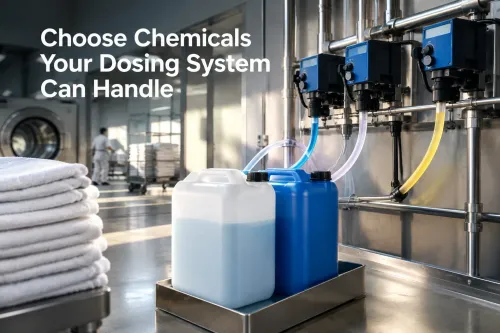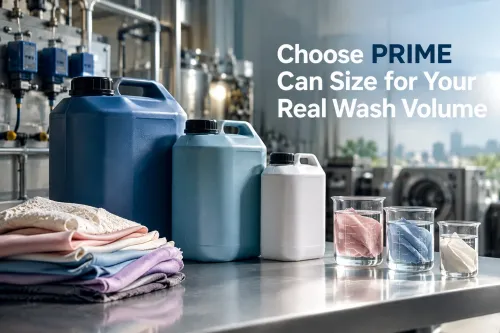


A larger container does not automatically produce whiter linen, and an emulsifier cannot correct every cause of dullness. You will be able to separate formulation performance from pack-size economics, diagnose the real source of poor whiteness, and choose a dose and container based on measured laundry results.
Key takeaways
- Equal formulations and dosing produce equal whiteness, regardless of container size.
- Emulsifier removes oily soil; it does not bleach or brighten fabric.
- Dose by liquor volume and product concentration, not container size.
- Compare whiteness on matched loads using the same wash formula and temperature.
Does 200-L or 100-L emulsifier produce whiter laundry?
Neither a 200-L nor a 100-L emulsifier produces whiter laundry when both contain the same formulation and are dosed at the same concentration. An emulsifier disperses oil and greasy soil so the main-wash detergent can work; it is not a bleach, optical brightener, detergent, water softener, or sour.
| Comparison point | 100-L option | 200-L option |
|---|---|---|
| Active matter and dose | Compare concentration and verified mL/kg of dry linen | Same checks; volume alone proves nothing |
| pH, density and solvent system | Check the technical data sheet | Check the technical data sheet |
| Oily-soil emulsification | Judge on light soil and low-temperature loads | Judge on heavy soil and high grease loads |
| Colour safety and residue risk | Confirm fabric compatibility and rinsing | Confirm the same; excess dose can leave film |
| Pack or formulation | Could mean a formulation size or container size | Could mean a formulation size or container size |
A 100-L or 200-L printed on a drum does not prove cleaning strength. For “is 200 l or 100 l better for laundry no whiteness in pune,” test the actual product against your water and textile mix: municipal, borewell, or blended water; cotton, polyester blends, and coloured linen.
The right 200 l emulsifier comparison in Pune uses equal measured concentration, dose, pH, and soil-removal results—not the product name or container volume.
Why can linen stay dull after you add an emulsifier?
Linen can stay dull after an emulsifier because an emulsifier disperses oil; it cannot correct redeposition from an overloaded machine or weak rinsing, calcium and magnesium scale from hard water, detergent underdosing, excessive chemical dosing that leaves a film, low wash temperature, inadequate wash time, poor rinse quality, or an incompatible or incorrectly timed bleach programme.
- Test incoming water for total hardness as CaCO3, alkalinity, pH, and iron. TDS alone cannot identify hardness, so do not approve a chemical change from a TDS reading alone.
- Check the process: weigh the load, confirm the liquor ratio, measure detergent and bleach delivery, count rinses, and test residual alkalinity. A programmed pump setting does not prove that the wash received the intended dose.
- Match the symptom to the fault. Grey soil points to overloading, redeposition, underdosing, or weak rinsing. Yellowing points to iron, poor bleaching, or a low-temperature or short-time process. Mineral deposits point to hardness and alkalinity. Lost optical brightness points to absent or degraded brightener, or a film masking its effect. Fading or patchy colour points to chlorine-sensitive dye damage from an incompatible or mistimed bleach programme.
Correct the measured cause before changing the emulsifier. Increasing it will not soften hard water, replace detergent or bleach, remove mineral scale, restore optical brightener, or repair dye damage.
How should you dose and run 100-L or 200-L emulsifier?
Dose either pack from the formulation, not the drum size. A 100 l emulsifier for laundry whiteness requires the same verified millilitres-per-kilogram rate as a 200 l pack only when the formulation and concentration match.
Before running the programme, obtain the supplier’s label or technical data sheet and confirm these details on the machine:
- The exact millilitres per kilogram of dry linen for light, medium, and heavy soil.
- The load calculation: dry-linen kilograms multiplied by the verified millilitres-per-kilogram rate equals the required millilitres per wash.
- The injection point, required contact time, and whether dilution is permitted or required.
- The formulation’s wash-temperature range and pH window. Do not substitute another product’s limits.
- Compatibility with cotton, polyester, cotton-polyester blends, coloured garments, and chlorine-sensitive dyes.
- The specified detergent, bleach, optical brightener, softener, and sour programme.
Calibrate the dispenser in millilitres rather than trusting its displayed setting. After every container change, measure delivery again: different viscosity, suction lift, liquid level, tubing diameter, foot-valve condition, or pump performance can change the dose. The emulsifier supplements the main wash; it cannot replace detergent, bleach, optical brightener, softener, or sour.
Stop the trial if temperature, pH, contact time, or dye compatibility falls outside the formulation’s stated window.
How can you compare whiteness fairly on the same laundry machine?
Compare A and B on the same machine by changing only the emulsifier, not the wash process.
- Build matched loads with identical textile composition and dry weight. Keep liquor ratio, water level, detergent dose, emulsifier dose per kilogram, bleach programme and dose, temperature, wash time, rinse count and extraction speed unchanged.
- Record incoming-water hardness as calcium carbonate, alkalinity, pH, iron and temperature before each trial set. Record pump calibration in millilitres, product batch numbers and the actual dose delivered.
- Run several repeated loads for each option, alternating A and B where practical. One successful batch cannot separate chemical performance from normal variation in fabric mix or soil.
Measure the same outcomes after every run:
| Measure | Record |
|---|---|
| Stain removal | Standardised stained pieces or scored linen |
| Visible greying | Same observer, lighting and rating scale |
| Colour change | Before-and-after comparison |
| Rinse residue | Residual alkalinity or conductivity check |
| Rewash rate | Percentage of loads or pieces returned |
| Rejected linen | Count and stated rejection reason |
Photograph representative linen before washing and after drying under fixed camera distance, lighting, background and exposure. Record reflectance under a defined method and illuminant, using AATCC TM110 or ASTM E313 when the instrument and laboratory method suit the textile; do not compare results from different methods without checking their conditions.
Visual inspection alone can mistake optical-brightener fluorescence for soil removal. A traceable improvement requires matching photographs, water records, pump checks and batch numbers, so a changed bleach dose or fabric mix cannot be credited to the emulsifier.
Which container size is economical and safe for your laundry?
The economical and safe choice is the smallest container you can consume within its opened shelf-life without compromising measured whiteness.
| Pack | Choose it when | Main risk |
|---|---|---|
| 5 L | Trial, low monthly consumption, or several formulations need testing | Higher packaging and handling cost |
| 20 L | Regular use with modest consumption | Product may age before the next order |
| 50 L | Stable demand and suitable chemical storage | More spill exposure and residual heel |
| 100 L | The laundry can use the container promptly with compatible dispensing equipment | A nominal volume can still leave unusable product |
| 200 L | High, predictable consumption and safe bulk transfer are available | Heavy handling, storage demands, pump losses, and aged residue |
Calculate monthly product consumption as monthly dry-linen kilograms multiplied by the verified dose in litres per kilogram. Compare delivered cost per usable kilogram and per kilogram of dry linen, including freight to Pune, residual heel, pump equipment, storage space, labour, spill controls, and rewash cost.
Select a larger emulsifier can size for commercial laundry only when storage has secondary containment, compatible suction tubing, seals, transfer equipment, and spill procedures. A full 200-L container can weigh about 200 times its density in kilograms before the container is added, so do not move it manually without a safe method.
For a 200 L emulsifier comparison in Pune, ask suppliers such as ALLIANCE INTERNATIONAL for the SDS, technical data sheet, active concentration, container compatibility, and verified dose. Choose the lowest safe cost at equal measured whiteness, not the lowest price per drum.
Related products
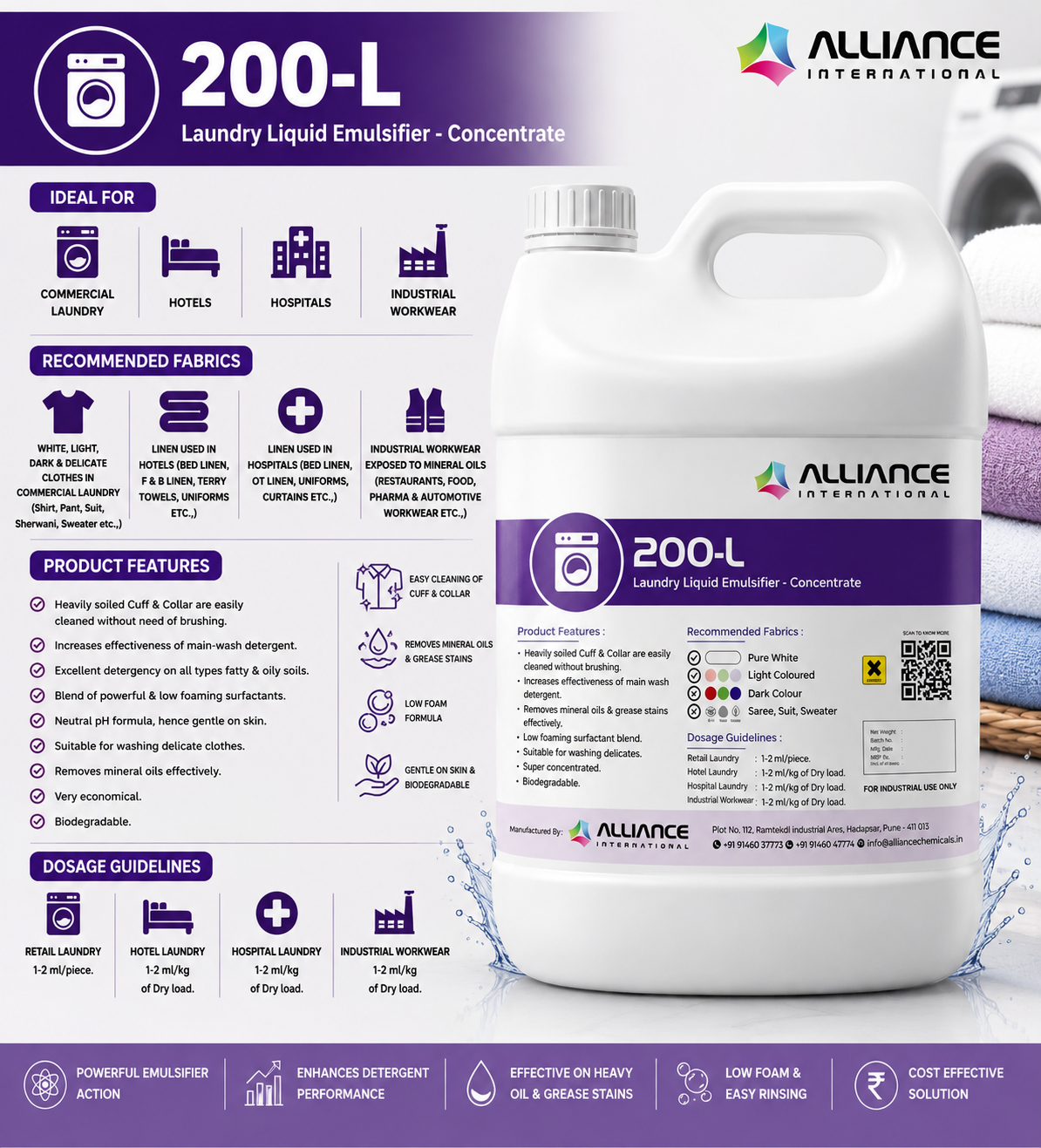 | Emulsifiers & Boosters ₹25000 Alliance's 200-L is a specially formulated laundry liquid emulsifier used along with main-wash detergent to assist in the removal of heavy soils... View product → |
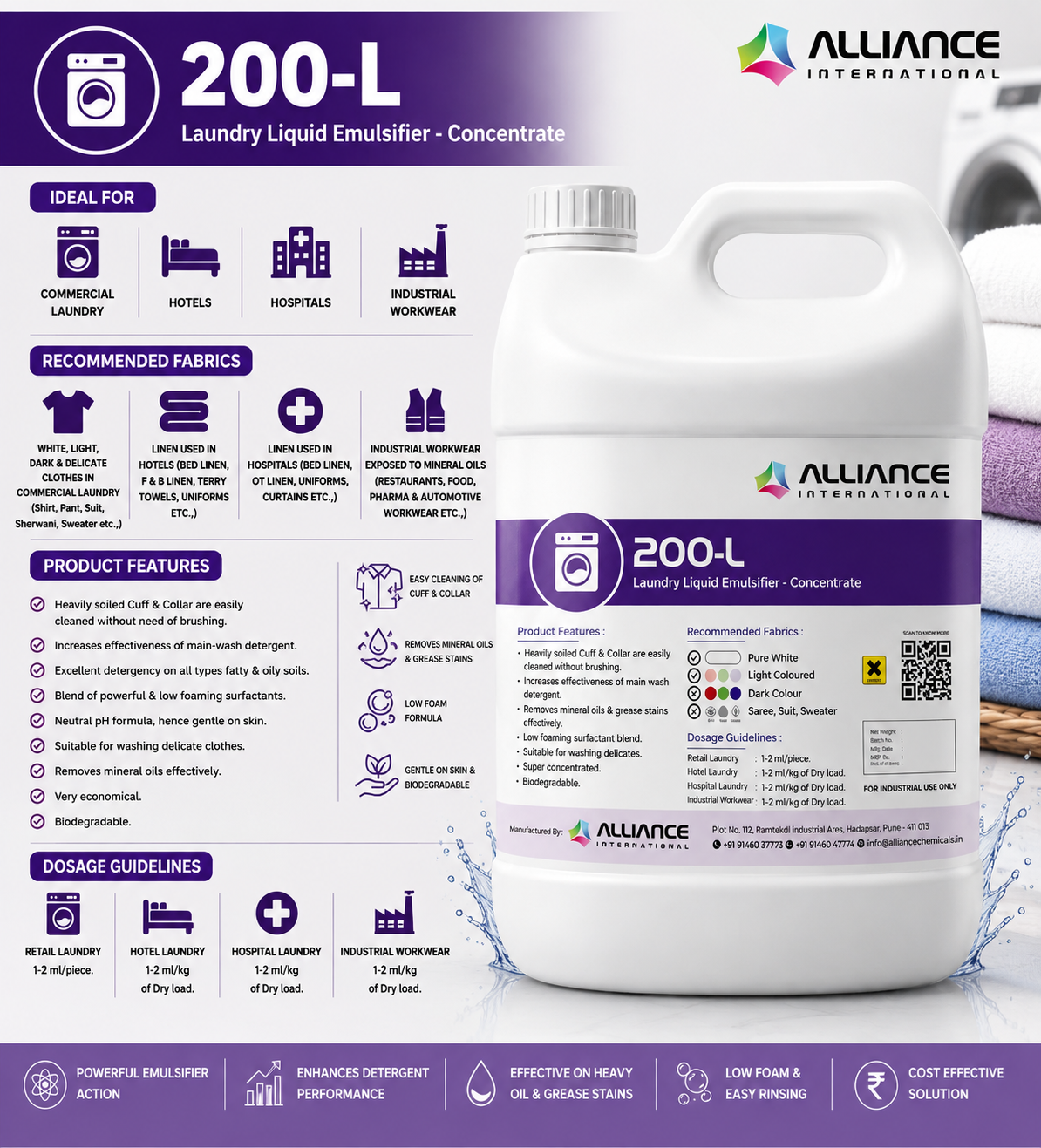 | Emulsifiers & Boosters ₹3500 Alliance's 200-L is a specially formulated laundry liquid emulsifier used along with main-wash detergent to assist in the removal of heavy soils... View product → |
Frequently asked questions
Does a 200-L or 100-L emulsifier produce whiter laundry?
No. If both containers hold the same formulation and you dose them at the same concentration, neither produces whiter laundry. Container size affects handling and cost, not cleaning chemistry.
Why can linen stay dull after adding an emulsifier?
An emulsifier disperses oil and greasy soil but is not a bleach, optical brightener, detergent, water softener, or sour. Dull linen can result from mineral deposits, detergent failure, redeposition, insufficient bleaching, or incorrect wash conditions.
How should you dose 100-L or 200-L emulsifier?
Follow the supplier’s dose per kilogram of dry linen or per litre of wash liquor. Measure the product accurately, keep the concentration identical between trials, and control load weight, water level, temperature, time, and other chemicals.
How can you compare whiteness fairly on the same laundry machine?
Run matched loads with the same fabric type, soil level, load weight, water volume, temperature, cycle time, detergent, bleach, and finishing process. Change only the emulsifier container or source, then compare the dried linen under identical lighting.
Which emulsifier container size is economical and safe for a commercial laundry?
Choose 200 L when your usage rate justifies bulk handling and you have suitable storage and transfer equipment. Choose 100 L when cash flow, space, lifting, spill control, or product age makes smaller stock safer. Compare cost per usable kilogram or litre, not container price alone.
Related products
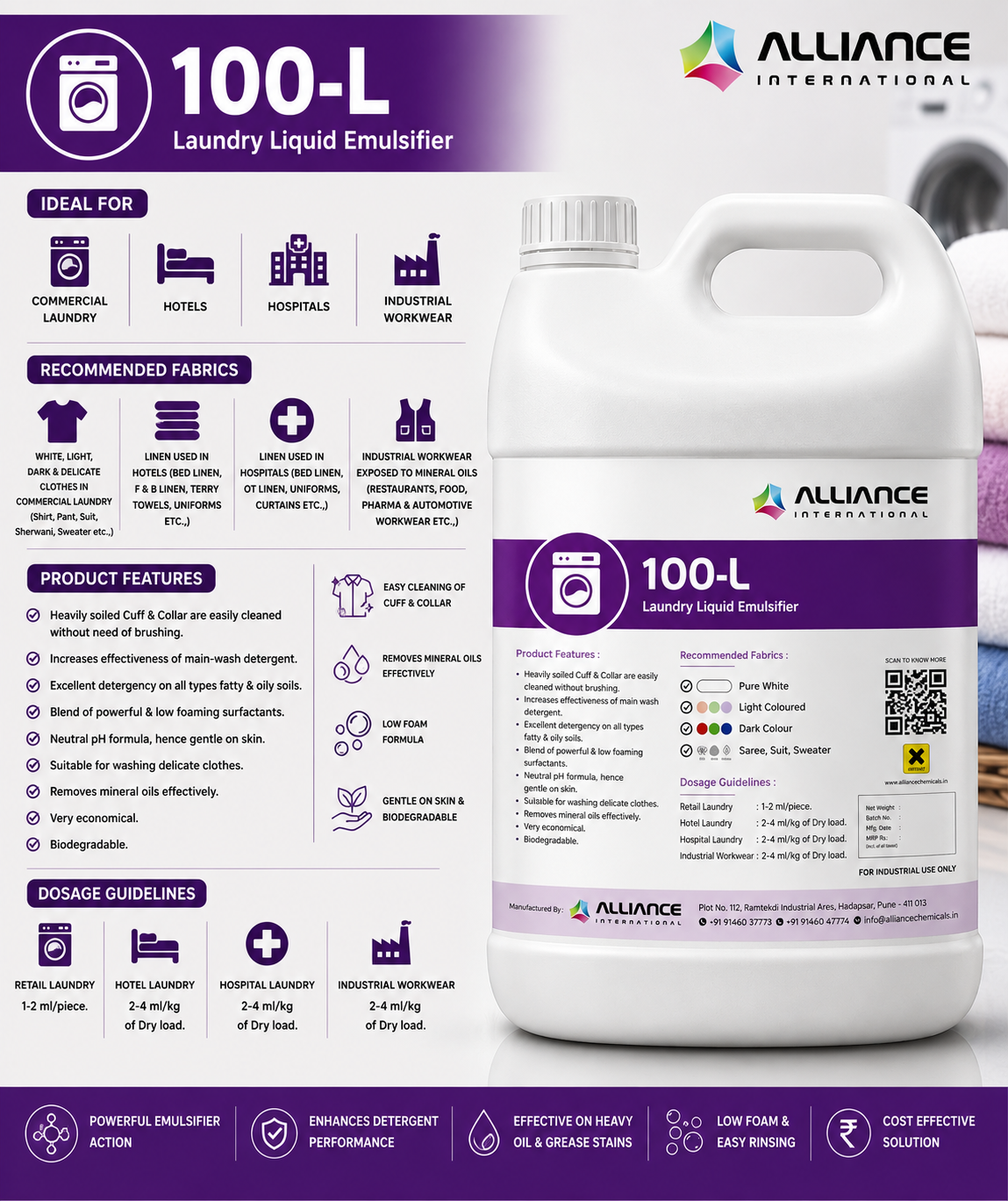 | Emulsifiers & Boosters ₹15000 Alliance's 100-L is a specially formulated laundry liquid emulsifier used along with main-wash detergent to assist in the removal of heavy soils... View product → |
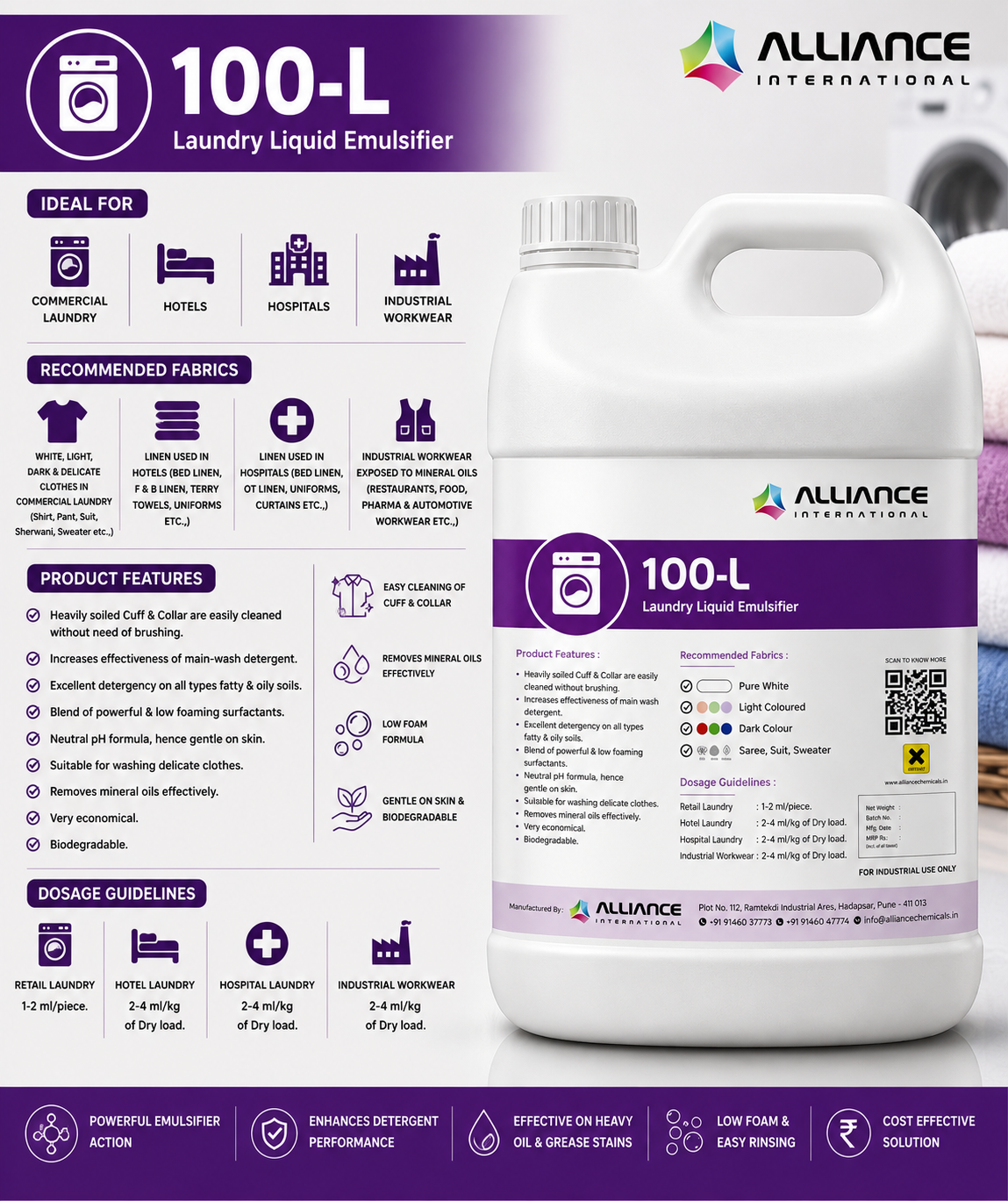 | Emulsifiers & Boosters ₹2500 Alliance's 100-L is a specially formulated laundry liquid emulsifier used along with main-wash detergent to assist in the removal of heavy soils... View product → |
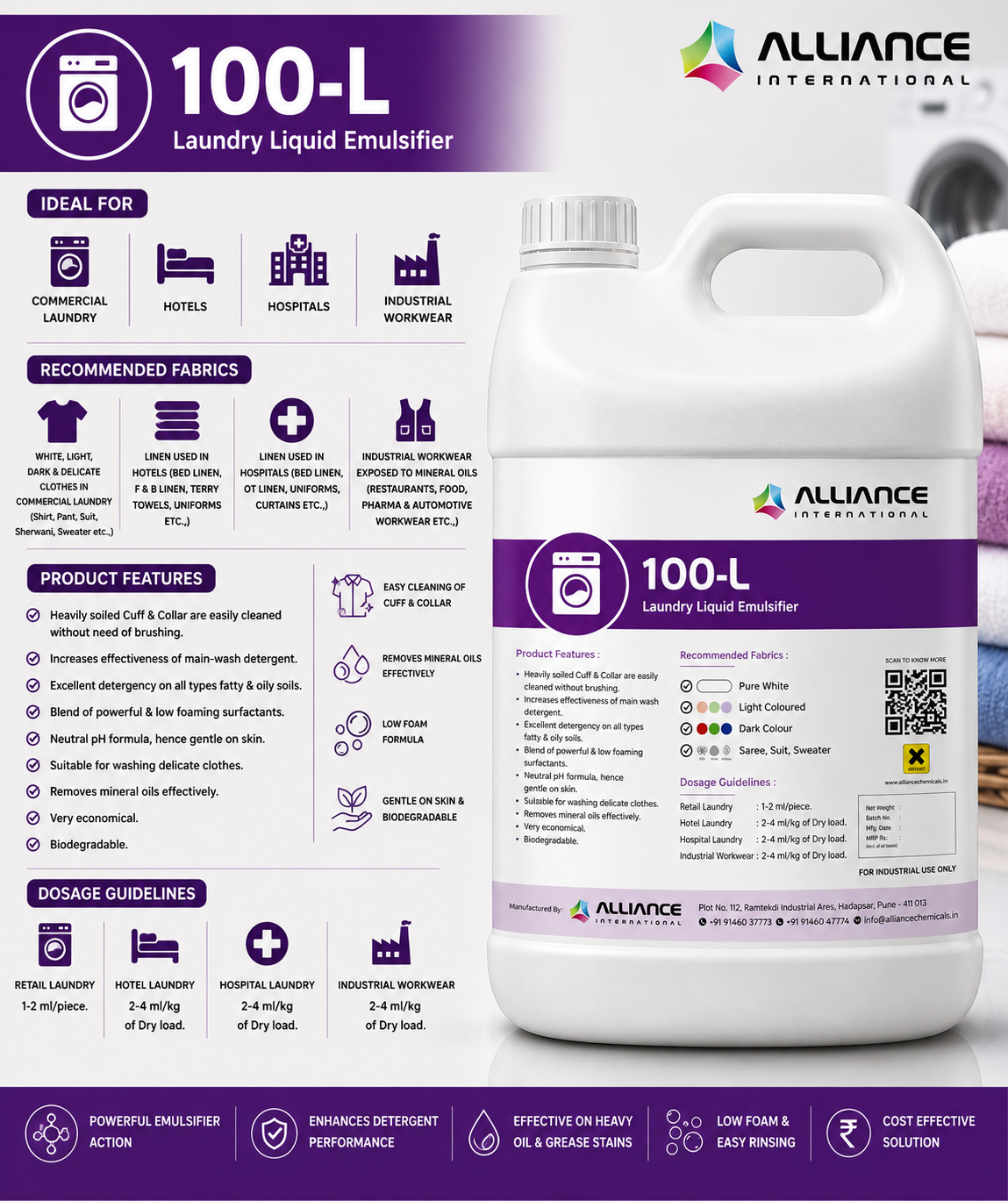 | Emulsifiers & Boosters ₹7000 Alliance's 100-L is a specially formulated laundry liquid emulsifier used along with main-wash detergent to assist in the removal of heavy soils... View product → |
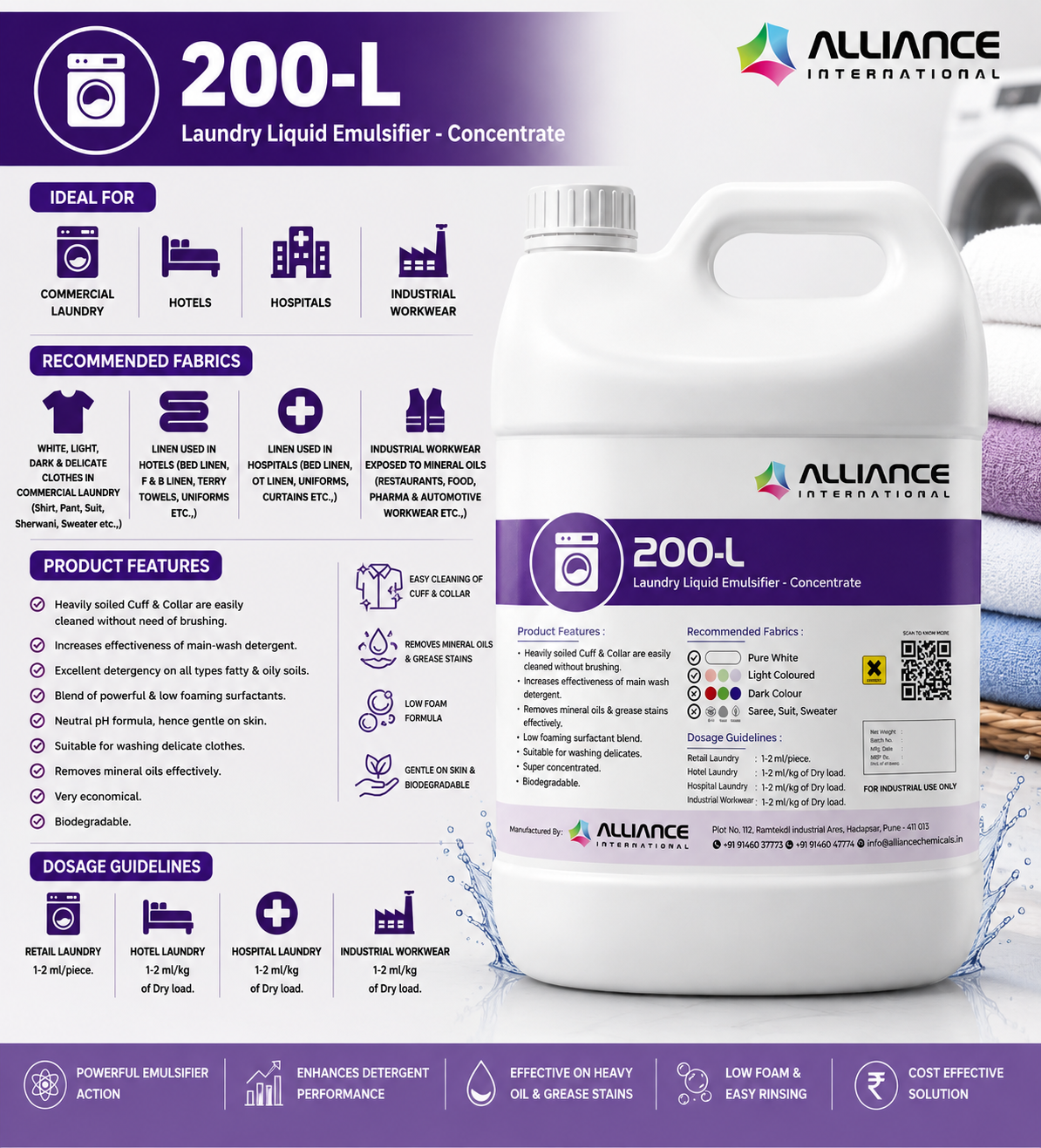 | Emulsifiers & Boosters ₹11000 Alliance's 200-L is a specially formulated laundry liquid emulsifier used along with main-wash detergent to assist in the removal of heavy soils... View product → |