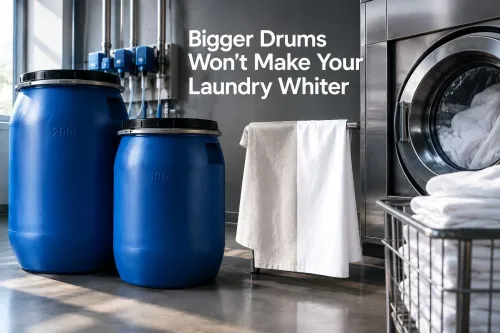

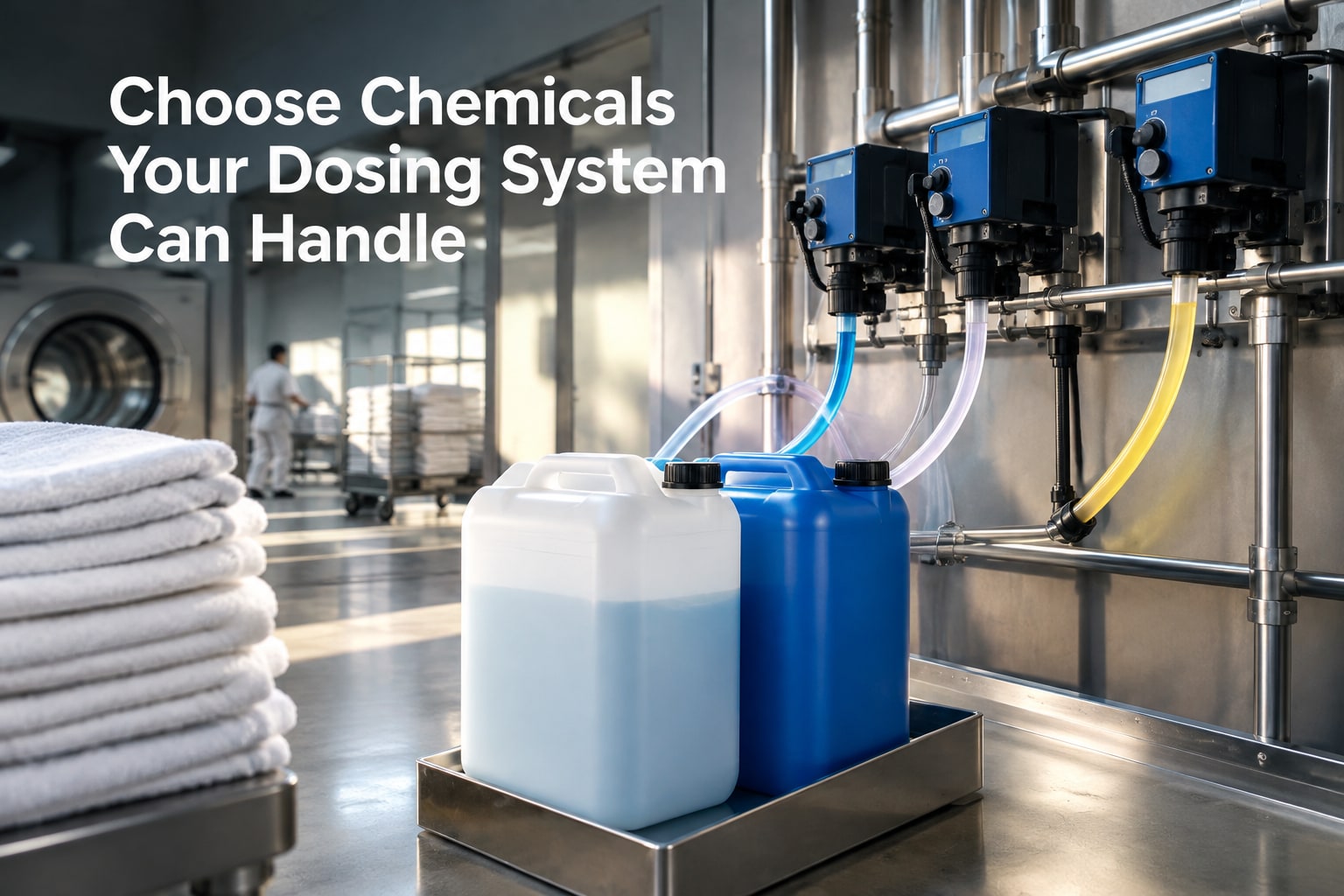
Grey, yellow or dull hospital linen is not automatically a detergent problem. Before you order a 100 L or 200 L chemical package, identify whether the cause is oily soil, hard-water deposits, poor rinsing, bleach damage, dye transfer or an incorrect wash process. By the end, you will have a practical specification for comparing Pune suppliers, checking container suitability and requesting a quotation that can be validated on your actual linen.
Key takeaways
- Identify grey, yellow, chalky or patchy linen before choosing a chemical.
- Match the formulation to soil type, fibre, temperature and wash process.
- Confirm 100 L or 200 L box dimensions and dosing-system compatibility.
- Set delivery, storage, acceptance and wash-performance checks before purchase.
Define what “no whiteness” means before choosing a chemical
Grey, yellow, chalky and patchy linen are different failures. Before you buy laundry chemical box for no whiteness in pune hospitals, identify the visible defect rather than ordering an emulsifier by description.
| Appearance | Likely cause | First check |
|---|---|---|
| Uniform grey | Retained body soil, detergent residue or optical-brightener loss | Detergent dose, soil load and rinse count |
| Yellow or rust-toned | Iron, chlorine overuse or fabric ageing | Water iron, bleach dose and textile history |
| White powder or mineral marks | Hard water, undissolved powder or poor rinsing | Water hardness and final rinses |
| Isolated coloured patches | Dye transfer | Mixed-load records and colour separation |
| Dull but otherwise clean | Low temperature, contact time, extraction or bleach performance | Wash record and delivered chemical dose |
Inspect in this order:
- Compare a freshly washed item with an unused item of the same textile.
- Check whether dullness is uniform or concentrated at cuffs, collars, towels or seams.
- Rub and inspect deposits for loose powder or hard mineral scale.
- Review wash temperature, chemical doses, contact time, extraction and rinse records.
- Test incoming water hardness and check for iron.
Visual whiteness does not prove hygienic processing. Record textile type, soil class, wash temperature, liquor ratio, detergent dose, bleach dose, rinse count and final pH before changing products. This prevents ordering an emulsifier when the real problem is scale, rust, dye transfer or insufficient bleaching.
Match the chemical to the soil, fibre and wash process
An emulsifier is the right purchase only when body oil, ointment, food grease or mineral oil remains on cuffs, collars, towels or engineering overalls. It disperses oily soil in the wash; it does not replace detergent alkalinity, oxygen or hypochlorite bleaching, thermal disinfection or rinsing.
| Option | Intended correction | Do not use it to correct |
|---|---|---|
| Emulsifier | Body oil, ointment, food grease or mineral oil | Grey linen caused by hardness, poor rinsing or low bleach performance |
| Main-wash detergent | Soil suspension, alkalinity and everyday cleaning | A defined heavy-oil problem without supporting chemistry |
| Detergent powder | Dry detergent delivery and builder action | Assuming more powder will remove yellowing or rust |
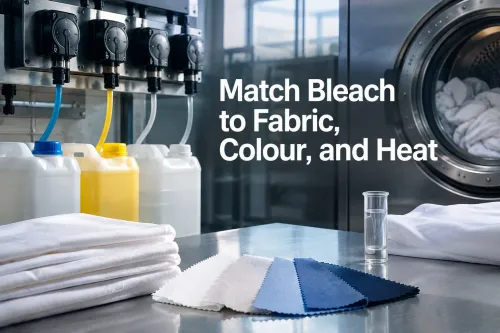
| Oxygen bleach | Organic stains and whitening on compatible coloured or white textiles | Replacing thermal disinfection or treating chlorine-sensitive fibres as chlorine-safe |
| Chlorine bleach | Disinfection and whitening where the textile and process permit | Polyester damage, colour loss, fibre weakening or iron staining |
Separate cotton sheets and towels from polyester blends, patient gowns, coloured uniforms, microfibre cloths and chlorine-sensitive articles before selecting the chemistry. A cotton towel and a coloured microfibre cloth do not share a safe bleach decision.
For a request to buy emulsifier box in Pune, give the supplier the soil description, textile list and wash process, not only the container size. Require these figures in writing:
- Dose in millilitres or grams per kilogram of dry linen
- Wash temperature, contact time and water-hardness range
- Compatibility with the selected detergent and bleach
- Recommended pH and rinse conditions
- Fibre restrictions and the dose for each listed soil class
A 100 L or 200 L box with the wrong dose only increases the cost of failure.
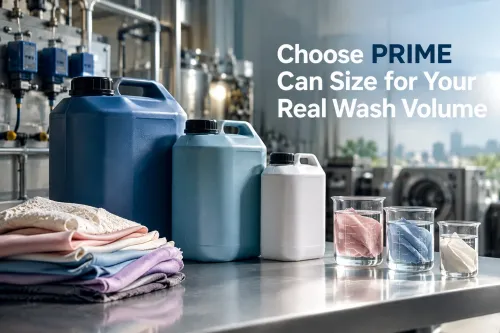
Check whether a 100 L or 200 L box fits the dosing system
A “100 L” or “200 L” label may name the formulation, not the container capacity. Ask whether it means a product grade or net chemical volume: a product described as 100 L may arrive in a 20 L box, a 50 L can or another package.
The 200 l laundry box for hospitals in pune must be specified physically, not chosen from the catalogue name.
Require these details in the quotation:
- Physical form: corrugated carton with inner liner, rigid HDPE drum, IBC or tank
- Chemical physical state, net volume, tare weight, dimensions and closure type
- Pallet footprint, usable fill volume, suction-tube reach and minimum pump pickup level
- UN transport classification, batch number and concentration or active-content specification
- Compatibility with the spill pallet, transfer fittings and dosing pump
A 200 L container can fail operationally if it cannot pass through the dosing room door, fit the spill pallet or leave less chemical than the pump inlet can draw. Measure the route and bund before ordering.
Test the 100 l laundry box for no whiteness against delivered dose, not package size. Require a dose in millilitres per kilogram of dry linen, pulse-to-volume conversion, an actual delivered-volume check and a recalibration method.
Collect a measured output over a fixed number of pulses, compare it with the target, then reset the pump and repeat. Pump run time alone becomes unreliable when viscosity or temperature changes.
Compare Pune suppliers by delivered performance, not box price
Compare suppliers on the delivered result per kilogram of dry linen, not on the price of a 100 L or 200 L box. A larger container can contain a weaker formulation, require a higher dose, or create more rewashing.
Your enquiry should state:
- Linen types: cotton sheets, towels, polyester blends, gowns or coloured uniforms
- Daily dry-linen weight and soil classes, such as body soil, ointment, food grease or mineral oil
- Washer capacity, water hardness, wash temperature and contact time
- Existing detergent, bleach, dosing pumps and preferred container format
- Delivery location, unloading access and required delivery schedule
Ask every hospital laundry booster box supplier for a technical data sheet, safety data sheet, batch identification, active-content or concentration specification, recommended dose in millilitres or grams per kilogram, compatibility statement, minimum order quantity, Pune delivery coverage, lead time, storage instructions, empty-container handling and return terms.
| Compare | Supplier A | Supplier B | Measure |
|---|---|---|---|
| Dose cost | ₹ per kg linen | ₹ per kg linen | Recommended dose and concentration |
| Process cost | Water, fittings and pump changes | Water, fittings and pump changes | Delivered dose, not pump run time |
| Quality cost | Rewash, rejected or damaged linen | Rewash, rejected or damaged linen | Recorded trial result |
| Logistics | Lead time and container returns | Lead time and container returns | Cost to the hospital |
ALLIANCE INTERNATIONAL is worth considering only if it converts “no whiteness” into a fabric-specific formulation, dosing plan and documented trial. Phrase the request plainly: “We need a trial and quotation for oily soil on cotton-polyester hospital linen,” followed by the measured process details.
That prevents “buy laundry chemical box for no whiteness in Pune hospitals” from producing an unsuitable product.
Related products
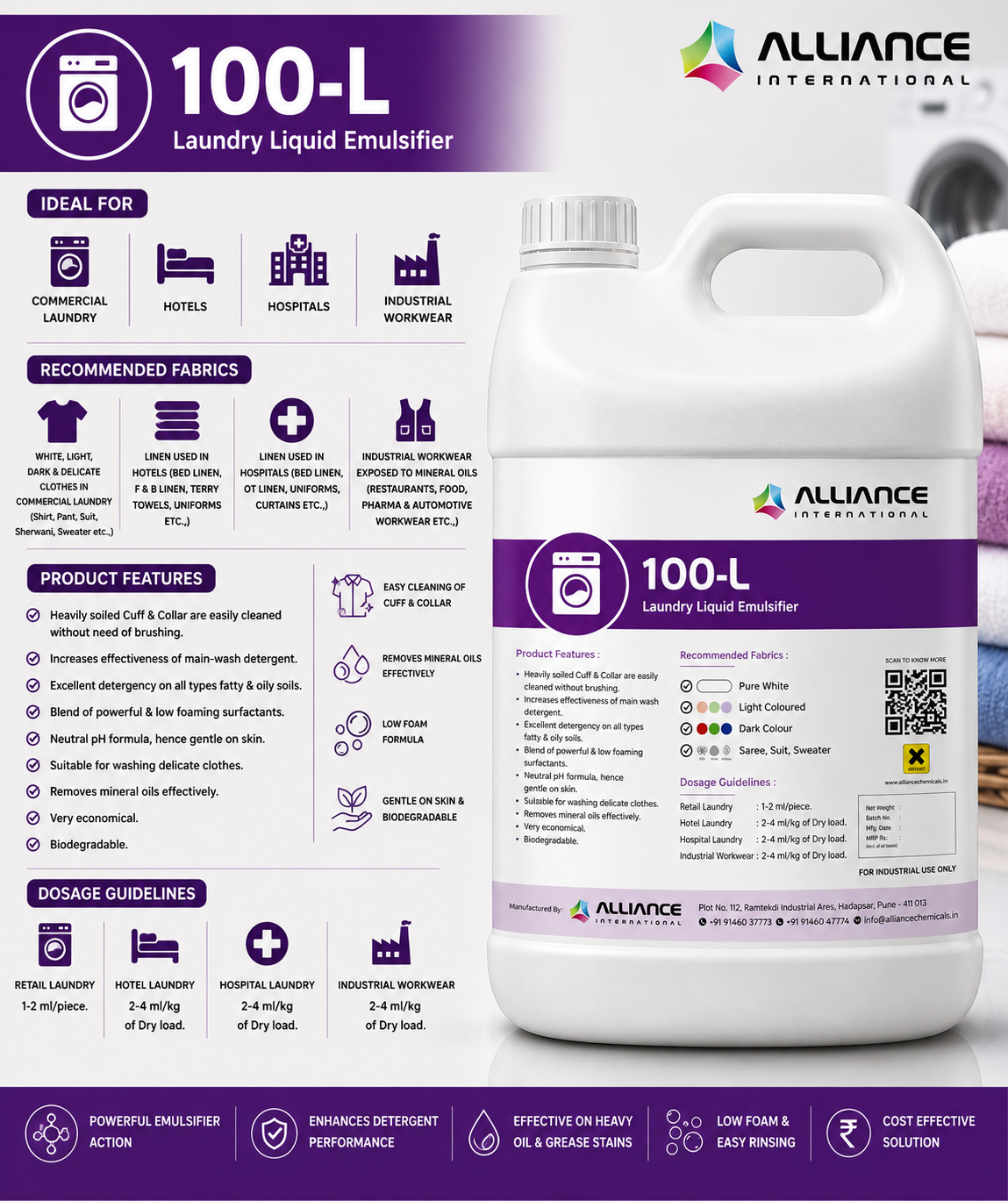 | Emulsifiers & Boosters ₹7000 Alliance's 100-L is a specially formulated laundry liquid emulsifier used along with main-wash detergent to assist in the removal of heavy soils... View product → |
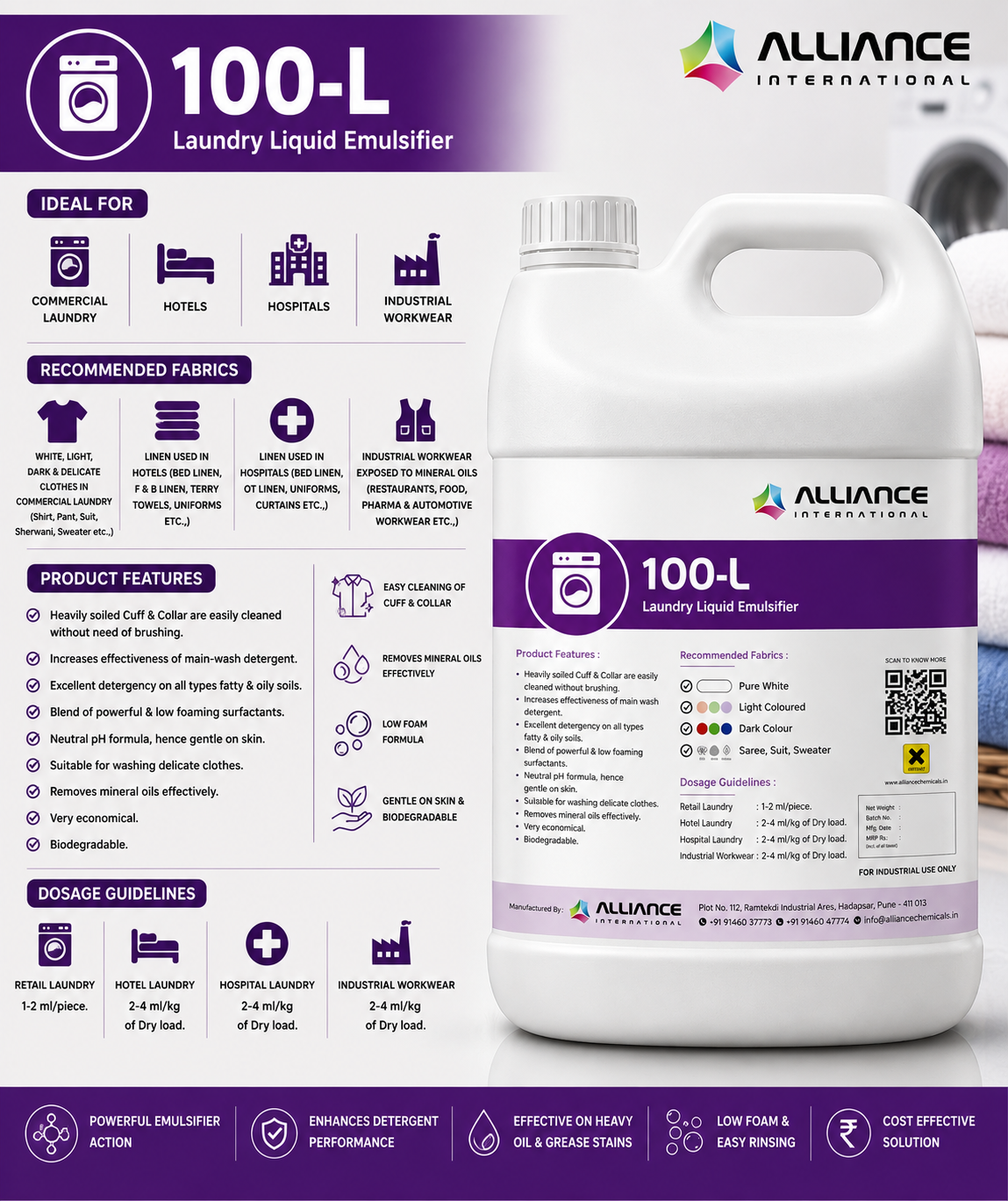 | Emulsifiers & Boosters ₹15000 Alliance's 100-L is a specially formulated laundry liquid emulsifier used along with main-wash detergent to assist in the removal of heavy soils... View product → |
Set acceptance, storage and validation requirements before delivery
Do not approve a laundry chemical from its box price alone. Set the acceptance, storage and trial conditions in the purchase specification before the shipment arrives.
1. Require a current safety data sheet, readable product label, batch number, delivery date, lot quantity and concentration or active-content specification. Record the recommended dose, target temperature, water-hardness range and compatible closed connection. Reject any container with an unreadable label, broken seal or missing batch identification.
2. Store the chemical in compatible secondary containment with a safe drum-moving method, eyewash access and a written spill response procedure. Use separate, labelled transfer lines for hypochlorite, acids, peroxide products, alkalis and concentrated surfactants. Acid contacting hypochlorite can release chlorine gas, so do not share unlabelled lines or common containment without a compatibility review.
3. Run a controlled trial on representative cotton, polyester-blend and coloured loads before approving the delivered box. Record the chemical concentration, temperature, contact time, mechanical action, rinse performance, final pH, residual soil, whiteness change and textile damage. A brighter sheet does not prove that the process meets infection-control requirements.
4. For reusable healthcare textiles, request industrial-laundering evidence and review ISO 15797 results for dimensional change, colour change and appearance after repeated processing. Approve the shipment only when the delivered dose and linen result match the quotation; otherwise quarantine the lot and investigate dosing, connection or batch variation.
Frequently asked questions
What does “no whiteness” mean in hospital laundry?
It describes a visible linen failure, such as greying, yellowing, chalky deposits or patchy whiteness. Identify the defect before selecting an emulsifier, booster or other chemical.
How do you match a laundry chemical to hospital linen?
Check the soil, fibre composition, wash temperature, cycle sequence, water quality and dosing point. A chemical that suits oily soil may not correct mineral deposits or fibre greying.
How do you choose between a 100 L and 200 L laundry chemical box?
Check the dosing pump, suction lance, box dimensions, chemical consumption rate and storage space. Confirm that the container fits the system before ordering.
How should Pune hospital laundry suppliers be compared?
Compare delivered whiteness, fabric condition, dosing consistency, technical support, documentation, storage requirements and acceptance-test results instead of comparing box prices alone.
Related product
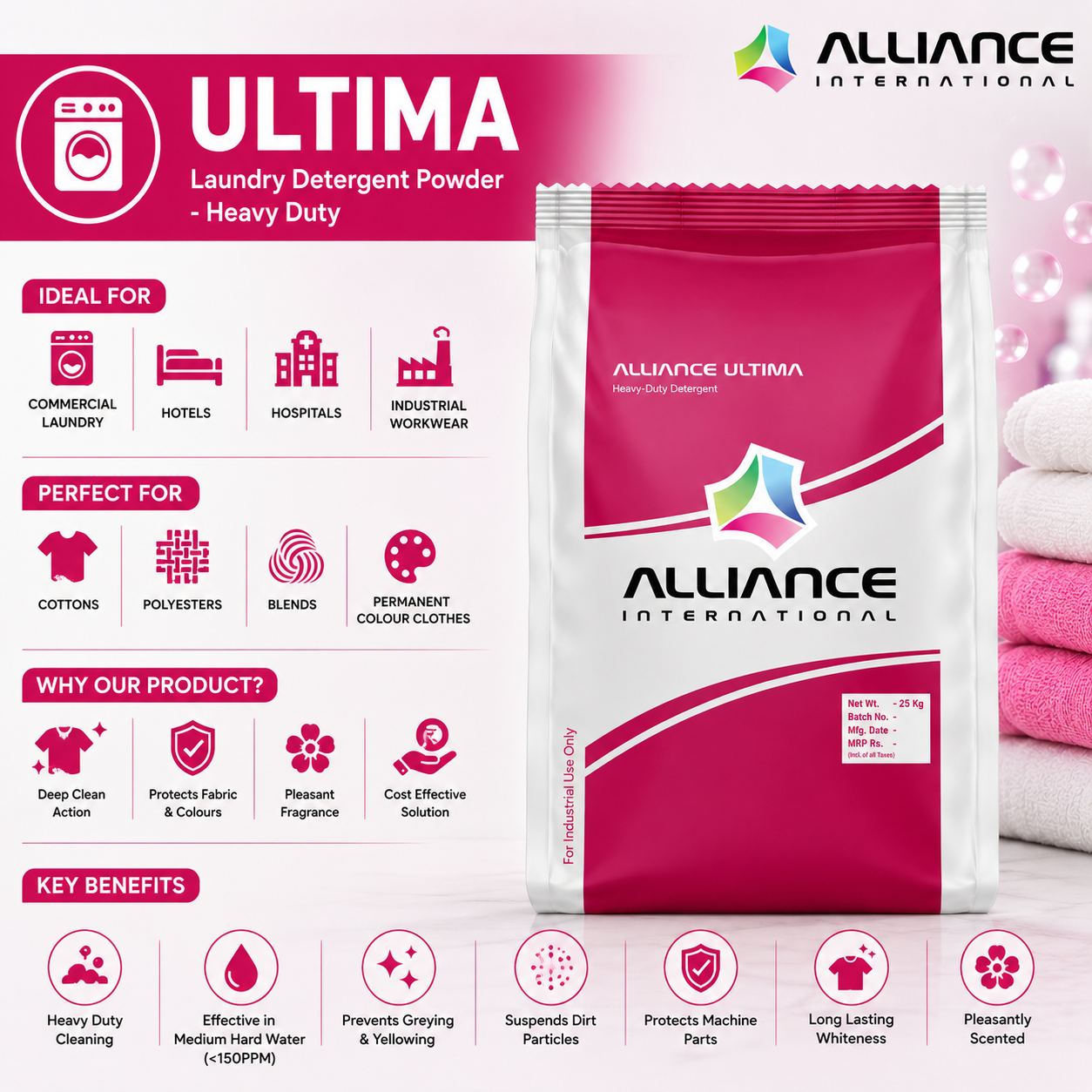 | Detergent Powder ₹7000 Alliance's ULTIMA is a specially formulated heavy-duty detergent powder recommended for main-line washing of all types of permanent colour clothes of... View product → |