
Grey or yellow linen does not prove that the bleach is weak. By checking fabric type, bath conditions, water quality, active concentration and residuals, you can decide whether to change bleach or correct the wash process first.
Key takeaways
- Use oxygen bleach for repeated cotton and polycotton washing when the data sheet confirms activation.
- Reserve hypochlorite for verified chlorine-compatible whites needing rapid stain decolourisation.
- Check dyed trims, fibre blends, colourfastness and chemical safety before changing bleach.
- Compare controlled-load results and total dosing cost, not whiteness alone.
Choose the bleach by fabric, colour and wash temperature
| Load | Preferred choice | Operating decision |
|---|---|---|
| White cotton sheets and towels | Oxygen bleach for repeated cycles | Use about 60–80°C when the product data sheet confirms activation. Reserve hypochlorite for verified chlorine-compatible whites needing rapid stain decolourisation. |
| Polyester or polycotton uniforms | Oxygen bleach | Check dyed trims, finishes and fibre blends before bleaching. |
| Coloured or permanent-colour uniforms | Oxygen bleach | Use only with the stated activator, temperature and contact time; chlorine can strip shade. |
| Healthcare linen | Segregated process | Separate coloured items, blood or protein soils, and chlorine-sensitive trims before selecting bleach. |
| Unknown mixed loads | Oxygen bleach | Choose it when correctly activated; do not expose unidentified fibres to chlorine. |
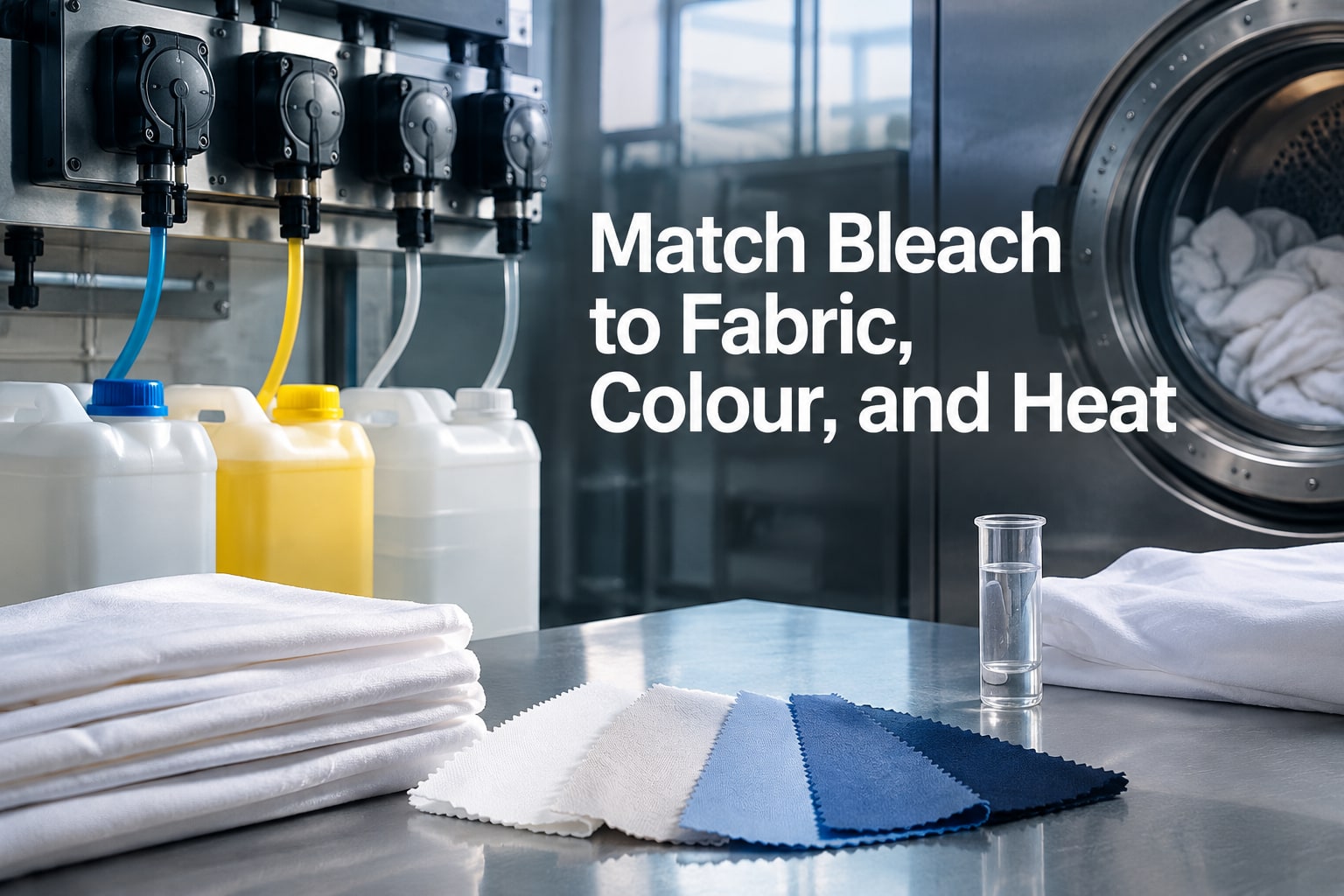
For a high-temperature oxygen process, work near 60–80°C. For a low-temperature hypochlorite process, work near 30–50°C. Add bleach only at the bath stage named in the current product data sheet, after the specified detergent and alkali stage, and hold the exact temperature and contact time stated there.
A cold, short oxygen bath leaves whites grey; excessive chlorine contact damages fibres.
White cotton is not automatically chlorine-safe. Trims, elastic, prints, finishes and blended fibres can fail before the cotton. Repeated towel cycles and elastane-containing garments favour oxygen bleaching.
The practical rule for whitol can or chlor for no whiteness problems in pune laundry is to verify the active chemistry first. In any whitol versus chlor laundry in pune decision, match chemistry to fabric and controlled process—not the larger pack or brightest first wash.
Compare active strength, dose and injection sequence
Compare usable bleaching capacity per kilogram of dry linen, not the size, colour or odour of the container.
For a commercial laundry bleach comparison in Pune, obtain the SDS and technical data sheet for each product and check active oxygen or peroxide concentration, available chlorine, pH, density, recommended dose, dilution requirement, storage temperature, shelf life and compatibility restrictions.
| Measure | Oxygen or peroxide product | Hypochlorite product |
|---|---|---|
| Active strength | Available oxygen or active peroxide concentration | Available chlorine concentration |
| Dose basis | Supplier dose in g or ml per kg dry linen | Supplier dose in g or ml per kg dry linen |
| Bath calculation | Active chemical ÷ wash-liquor volume in litres | Available chlorine ÷ wash-liquor volume in litres |
| Process risk | A cold, short bath can leave whites grey | Age, heat, sunlight, metal contamination and repeated opening reduce strength |
Use the supplier’s stated dose for the first controlled load. Record pH, temperature, contact time and peroxide or available-chlorine residual; adjust one variable at a time. Do not infer strength from pack size or appearance.
- Add detergent and alkali, then inject bleach only at the specified bath stage.
- Never mix concentrates. Keep hypochlorite on a separate line from acids, sour, ammonia and acidic detergent.
- Flush the line with the validated water volume between products, and lock out incompatible pumps during maintenance.
A pump set to the label concentration can under-dose degraded chlorine. Verify delivered strength rather than increasing dose blindly.
Diagnose the real cause of grey, yellow or uneven whites
If “whitol can no whiteness” or “chlor bleach no whiteness” describes the complaint, test the wash process before changing bleach.
1. Weigh the load and check loading percentage, liquor level and drum movement. Overloading or weak liquor circulation causes poor soil suspension and grey whites.
2. Verify detergent dose, main-wash time, bath temperature and alkalinity against the formula. Low detergent leaves soil behind; a cold, short or weakly alkaline bath encourages redeposition.
3. Check rinse count and final rinse quality. Chlorine odour means residual chlorine remains because rinsing or neutralisation is insufficient.
4. Test incoming water for total hardness, alkalinity, iron and manganese. TDS alone cannot identify these faults. Hard water creates scale and reduces detergent performance; iron or manganese produces yellow, beige or rust-coloured marks.
5. Separate the causes before acting. Dye transfer needs segregation and colour-control review. Low bleach strength needs an active-strength check. Rust-coloured spots require source control plus a validated iron-control or souring process. Do not increase chlorine against iron: oxidation can make metal deposits more visible.
6. Check dosing accuracy and liquor movement when bleaching is uneven. Confirm optical-brightener compatibility with the detergent, bleach and textile finish; brightener can mask residual soil without removing it. Whiteness that disappears after drying points to temporary optical effect, residual soil or fibre damage.
Record each result before changing one variable. This prevents a bleach replacement from hiding a loading, water-quality or rinsing failure.
Check colourfastness, fibre damage and chemical safety
A white-cotton pass does not clear a production load: elastane, nylon, wool, silk, trims, coatings and elastic can fail first.
- Elastane or elastic: prefer oxygen; reject chlorine unless the garment maker confirms compatibility.
- Nylon or dyed polyester: test for shade loss and yellowing.
- Wool or silk: exclude hypochlorite; protein fibres can weaken rapidly.
- Printed trims or coatings: check print adhesion, colour and surface finish.
- Unknown fibres: quarantine and identify the fibre before bleaching.
For colourfastness, find a hidden seam and apply correctly diluted bleach at the intended temperature and contact time. Rinse and dry it, then compare shade, strength, surface and odour with an untreated piece. Reject the load for colour change, yellowing, pinholes or weakening.
| Option | Colour safety and whiteness | Odour, residuals and rewash risk |
|---|---|---|
| Oxygen | Safer for permanent colours, repeated towels and mixed fibres; retains whiteness when activated correctly | Lower odour and less continuing fibre attack; cold or short cycles can leave grey soil |
| Hypochlorite | Fast decolourisation on verified chlorine-compatible whites; higher shade-loss risk | Chlorine odour and residuals demand thorough rinsing; rewash, tendering and yellowing risk increases |
Hypochlorite can cause tendering, pinholes, elastane degradation, protein-fibre damage and continuing attack from residual chlorine. Wear chemical-resistant gloves, goggles or a face shield and protective clothing; provide ventilation, labelled containers and a written spill procedure.
Never mix hypochlorite with acids, ammonia, acidic descaler, sour or acidic laundry products. The reaction can release toxic chlorine gas or chloramines. This is the essential safety rule for any “whitol versus chlor laundry in pune” decision.
Prove the changeover with a controlled load and true cost
Run a representative before-and-after trial on the same textile lot, soil load, machine, liquor ratio, detergent, alkali, temperature profile, bleach contact time and rinse sequence. This isolates the bleach; otherwise, you are comparing two complete wash processes.
For a Whitol Can or Chlor for no whiteness problems in Pune laundry decision, use production-like linen, not a hand-sized test.
- Record bath pH, active dose per kilogram, available-chlorine or peroxide residual, final sour pH and fabric condition.
- Compare prewash and postwash reflectance or whiteness readings with colour-change checks, fabric inspection and residual-chlorine testing.
- Repeat the wash cycle and check whiteness retention, tensile or tear damage, odour, yellowing and pinholes.
| Cost item | Calculation |
|---|---|
| Chemical use | Actual chemical cost per kilogram of dry linen |
| Water | Dilution water plus rinse-water volume and treatment cost |
| Energy | Heating energy for the recorded temperature profile |
| Labour | Dosing time, rewash labour and manual handling |
| Failure cost | Rejected linen, replacement value and damage-related downtime |
A commercial laundry bleach comparison in Pune is incomplete if it compares only a 25-litre can with a 50-kilogram pack. Ask ALLIANCE INTERNATIONAL or any supplier for the current SDS, technical data, batch information, active-strength test method and compatibility limits before setting a pump; verify suitability for the actual load.
Keep the change only when whiteness improves without higher rewash, damage or safety costs. If both bleaches fail, correct loading, water level, rinse quality, detergent selection or soil removal instead.
Related products
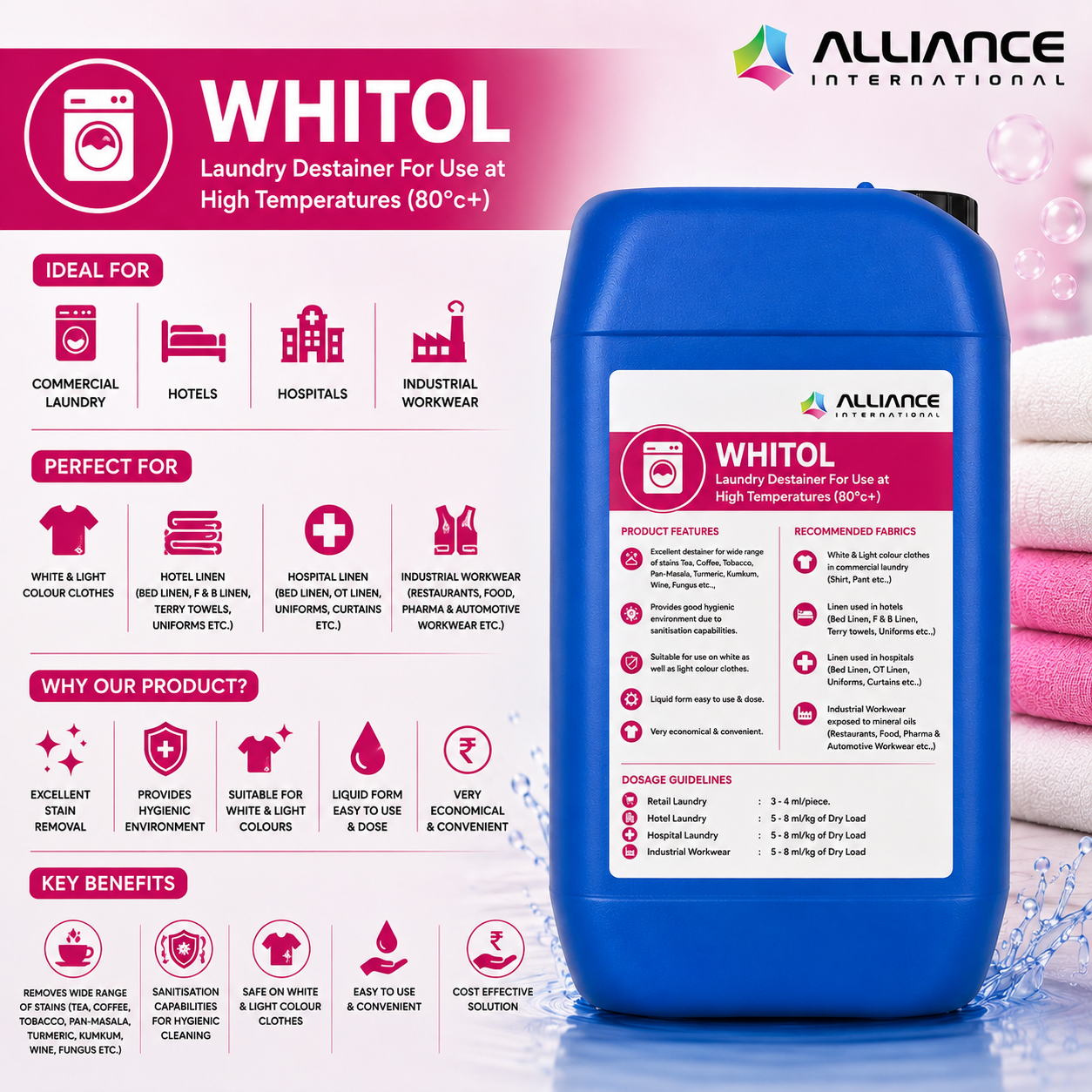 | Bleaches ₹7000 Alliance's WHITOL is a high temperature laundry detainer based on oxygen bleaching agents. View product → |
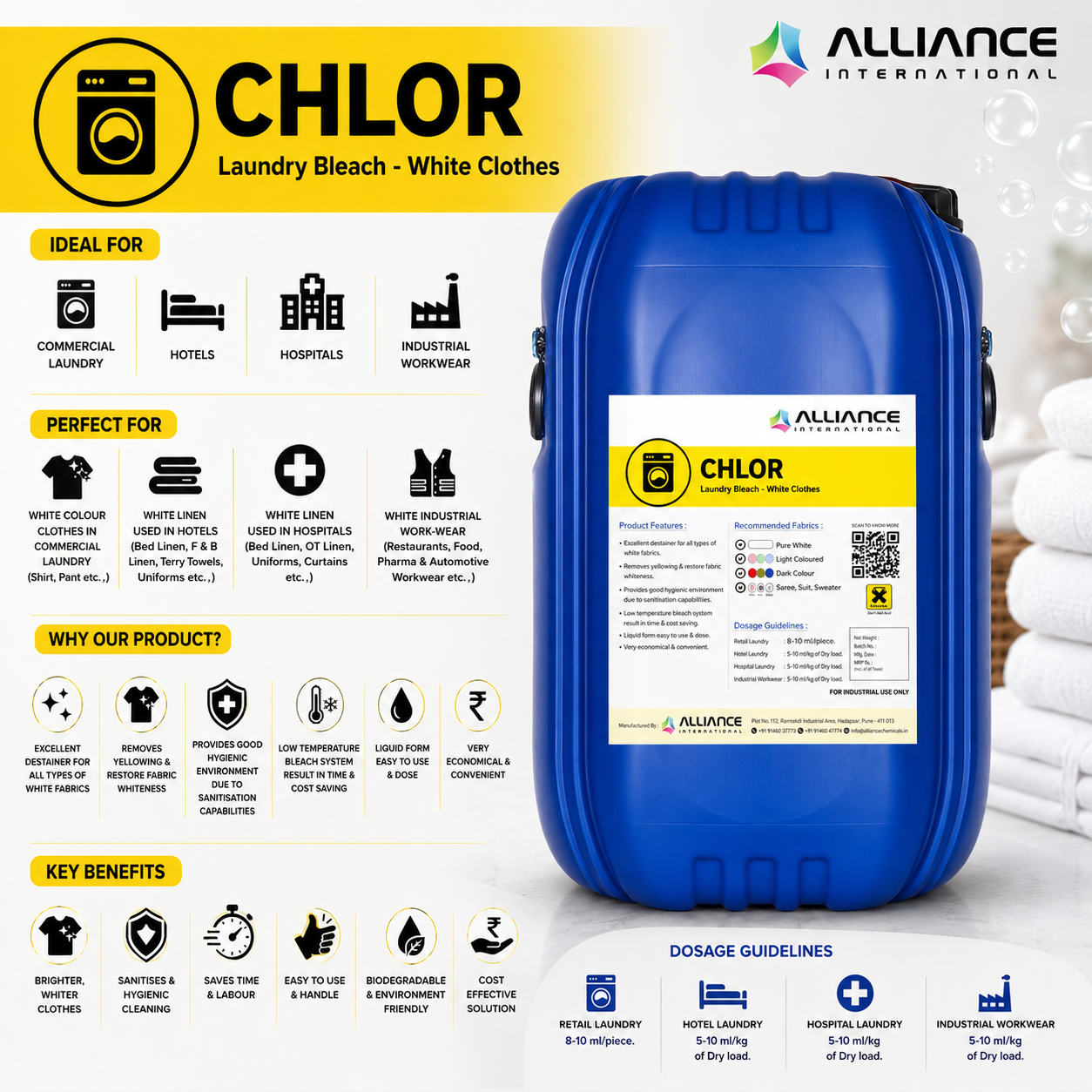 | Bleaches ₹3000 Alliance's CHLOR is low temperature laundry bleach based on hypochlorite & alkali. View product → |
Frequently asked questions
Which bleach suits white cotton sheets and towels?
Use oxygen bleach for repeated cycles at about 60–80°C when the product data sheet confirms activation. Reserve hypochlorite for verified chlorine-compatible whites needing rapid stain decolourisation.
Which bleach suits polyester or polycotton uniforms?
Choose oxygen bleach, then check dyed trims, finishes and fibre blends before bleaching.
How should you compare Whitol and Chlor in a commercial laundry?
Compare active strength, dose, wash temperature and injection sequence, then run a controlled load and measure whiteness, fabric damage and total chemical cost.
What causes grey, yellow or uneven whites besides the bleach?
Check soil redeposition, incorrect dosing, wash temperature, injection timing, water quality, overloading and chemical incompatibility before changing bleach.