
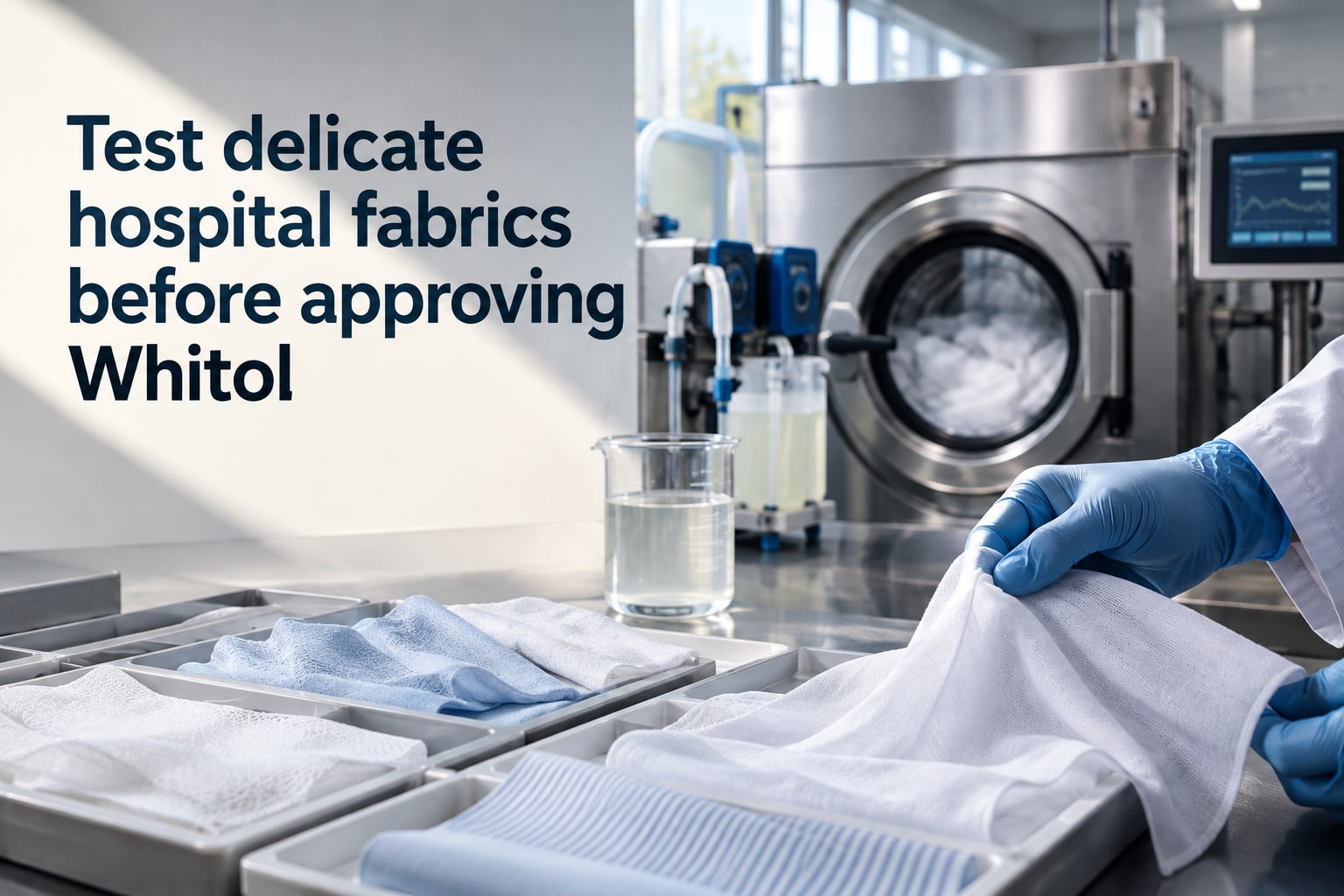
A bleach name alone cannot show that a product is safe for stretch scrubs, isolation gowns, privacy curtains or other healthcare textiles. You will be able to identify the formulation, reject unsuitable fabrics, set up a controlled trial and decide whether the wash process removes stains without confusing whiteness with disinfection.
Key takeaways
- Identify the Whitol formulation, batch, concentration, and safety documents.
- Exclude wool, silk, elastane, coated fabrics, and untested dyed textiles.
- Control dosage, temperature, contact time, pH, and rinsing.
- Approve Whitol only after a documented pilot shows no damage or residue.
What must you verify before using Whitol on hospital textiles?
Do not approve Whitol for hospital textiles until the exact Pune supply lot is identified and its documents support a textile-safety decision. The name “Whitol” or “bleach” does not identify the chemistry: chlorine, oxygen and whitening formulations require different controls.
Obtain the lot’s label, safety data sheet and technical data, then verify:
- Active ingredient and, if applicable, available-chlorine concentration.
- pH, intended use and stated textile restrictions.
- Storage temperature, shelf life and batch number.
- Mixing instructions, dilution requirements and dosing precautions.
- Incompatibilities, including contact with acids, ammonia or other laundry chemicals.
- A written compatibility statement covering the exact hospital categories: scrubs, sheets, gowns, curtains, mattress covers, barrier fabrics, printed garments and coloured or stretch textiles.
Stain removal and disinfection are separate claims. A garment can look white without the wash achieving a validated hygienic outcome; a disinfecting concentration can still fade dyes, weaken fibres or damage finishes. Do not treat whitening performance as evidence of disinfection.
If the supplier cannot identify the formulation and provide restrictions for the actual garments, you cannot call it safe. That documentation is the only defensible basis for assessing whitol for delicate hospital laundry problems in pune or whitol for sensitive fabric cleaning. The garment-care label and textile manufacturer’s compatibility data still take precedence.
Which delicate healthcare fabrics need exclusion or separate testing?
A generic “permanent-colour” or “delicate” claim does not cover every hospital garment. Exclude the following items or test them separately against the exact formulation, concentration and wash process.
| Fibre, finish or component | Main risk | Decision |
|---|---|---|
| Cotton and polyester-cotton scrubs | Coloured dyes can fade; blends can respond differently from white cotton | Test coloured and white garments separately |
| Elastane or spandex | Loss of stretch and poor recovery | Exclude unless compatibility data covers the blend |
| Rayon | Weakness, shrinkage or distortion when wet | Separate testing required |
| Wool and silk | Yellowing, strength loss and surface damage from chlorine | Do not use chlorine as the default |
| Flame-resistant textiles | Chemical treatment can alter the protective finish | Require the textile maker’s written approval |
| Waterproof or coated laminates | Coatings can peel, crack or lose repellency | Test the laminate, seams and backing |
| Barrier fabrics | Chemical exposure can change liquid or microbial-barrier performance | Require barrier-specific data |
| Printed garments, bonded seams and trims | Prints, adhesives and tapes can fade, loosen or delaminate | Inspect separately after repeated washing |
Chlorine products are a poor default for wool, silk, elastane, chlorine-sensitive dyes and some finishes because hypochlorite can cause yellowing, fading, strength loss and poor stretch recovery. The garment-care label and textile manufacturer’s compatibility data override a generic product claim.
For hospital delicate clothes washing problems, segregate by fibre, colour, soil level, flame-resistant status and barrier construction—not colour alone. A white cotton sheet cannot predict results on coloured scrubs, laminated gowns or printed labels.
Treat Whitol bleach for delicate hospital garments as unapproved until a written compatibility statement covers those categories and controlled testing confirms shade, strength, stretch and finish performance.
What wash controls prevent bleach damage and unreliable results?
Do not run Whitol for sensitive fabric cleaning from a capful or splash. Approve a written, repeatable formula and measure each batch.
- Record the product concentration, millilitres per kilogram of dry linen, liquor ratio, dilution method, dosing point, wash-stage temperature, contact time, pH, soil load, detergent interaction, rinse sequence and any compatible neutralising step.
- Treat a high-temperature description as incomplete until the formula states the target and maximum temperature, then measure the actual bath temperature. A hotter wash can accelerate fibre, dye and elastane damage.
- Use a controlled commercial washer or automatic dosing system that dilutes the chemical before it reaches the load. Never allow concentrated product to contact fabric directly.
- Separate whitening from disinfection. Whitol bleach for delicate hospital garments cannot be treated as a validated disinfecting process without evidence for the intended claim.
Blood, faeces, body fluids and heavy protein soil consume hypochlorite and reduce available chlorine. Adding more chemical can increase textile damage without repairing an uncontrolled soil load or exposure time.
Never mix chlorine products with acids, acidic descalers, ammonia or incompatible chemicals; dangerous chlorine-containing gases can result. Use separate, clearly labelled dosing lines and containers.
Build the formula around an adequate rinse and, where specified, a compatible neutraliser. No bleach smell does not prove that residual chemical is gone. Test the formula on representative fabrics, including coloured scrubs, elastane blends, coated items and prints, before production use.
How should you run a Pune pilot before approving Whitol?
Run a controlled pilot on production equipment before approving Whitol for delicate hospital laundry problems in Pune. Test actual garments, actual water and the intended dosing system; a white cotton sheet alone cannot predict damage to coloured scrubs, laminated gowns or printed labels.
1. Collect representative samples of coloured cotton-polyester scrubs, elastane blends, barrier or laminated items, printed garments, curtains and mattress-cover fabrics. Keep untreated controls from every category and record each fabric’s fibre content, colour, finish and care label.
2. Use the same washer, dosing equipment and process planned for production. Measure shade change, tensile or seam strength, elastane recovery, absorbency, odour and residual chlorine after laundering; inspect trims, coatings, bonded areas and printed surfaces for cracking, peeling, fading or distortion.
3. Test the Pune laundry inlet water for hardness, alkalinity, iron, manganese and pH, then repeat sampling across seasonal conditions. These results affect bleach stability, detergent performance, redeposition and fabric feel, so do not substitute assumed municipal-water values.
4. Ask Alliance International for the Pune supply lot’s technical sheet, safety data sheet, compatibility statement and dosing guidance for the proposed delicate healthcare laundry bleach in Pune. Require the hospital laundry and infection-control teams to review those documents, confirm an adequate rinse and validate any specified neutralisation step.
No bleach smell does not prove that residual chemical is gone. Reject the pilot if any control shows unacceptable damage or residuals.
Related products
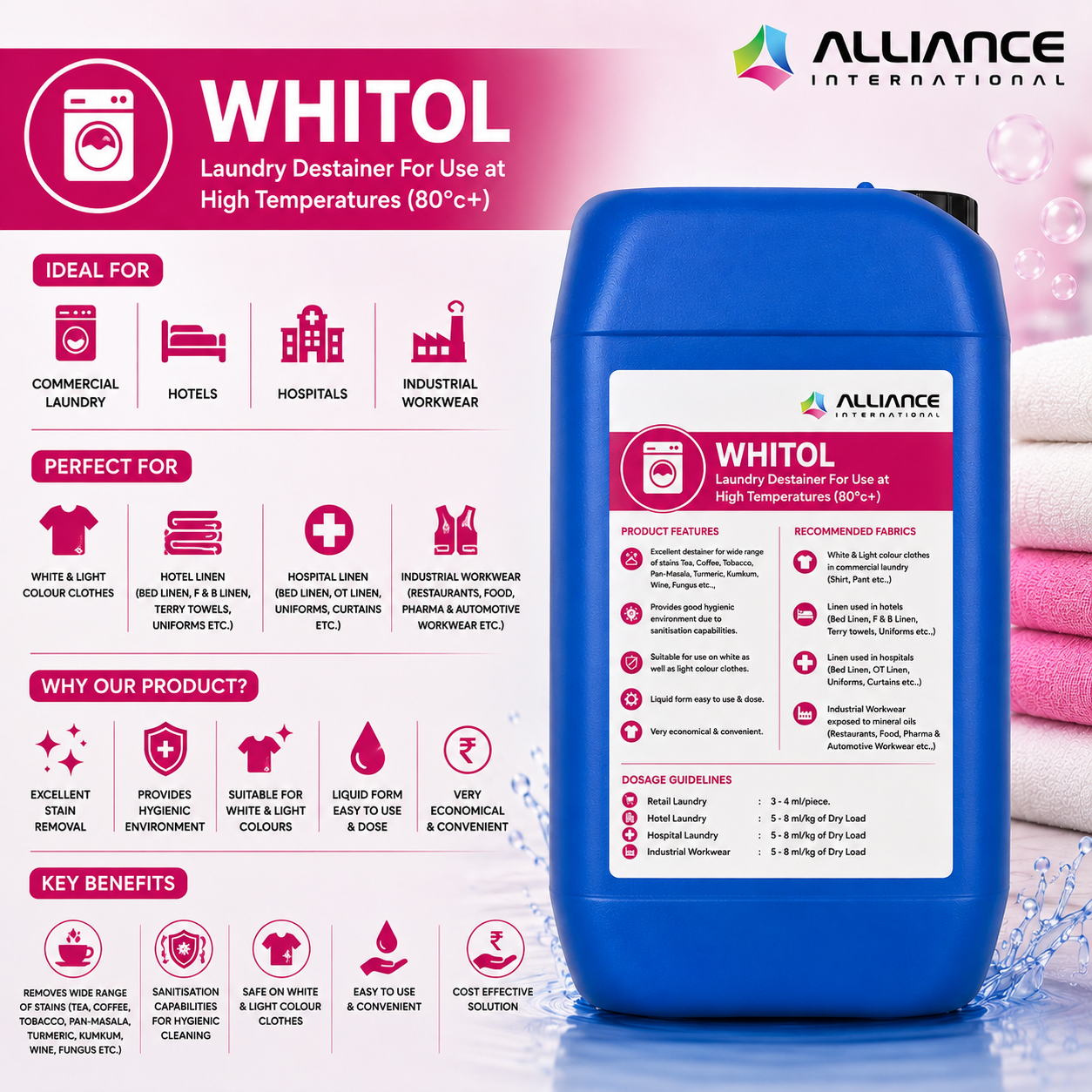 | Bleaches ₹7000 Alliance's WHITOL is a high temperature laundry detainer based on oxygen bleaching agents. View product → |
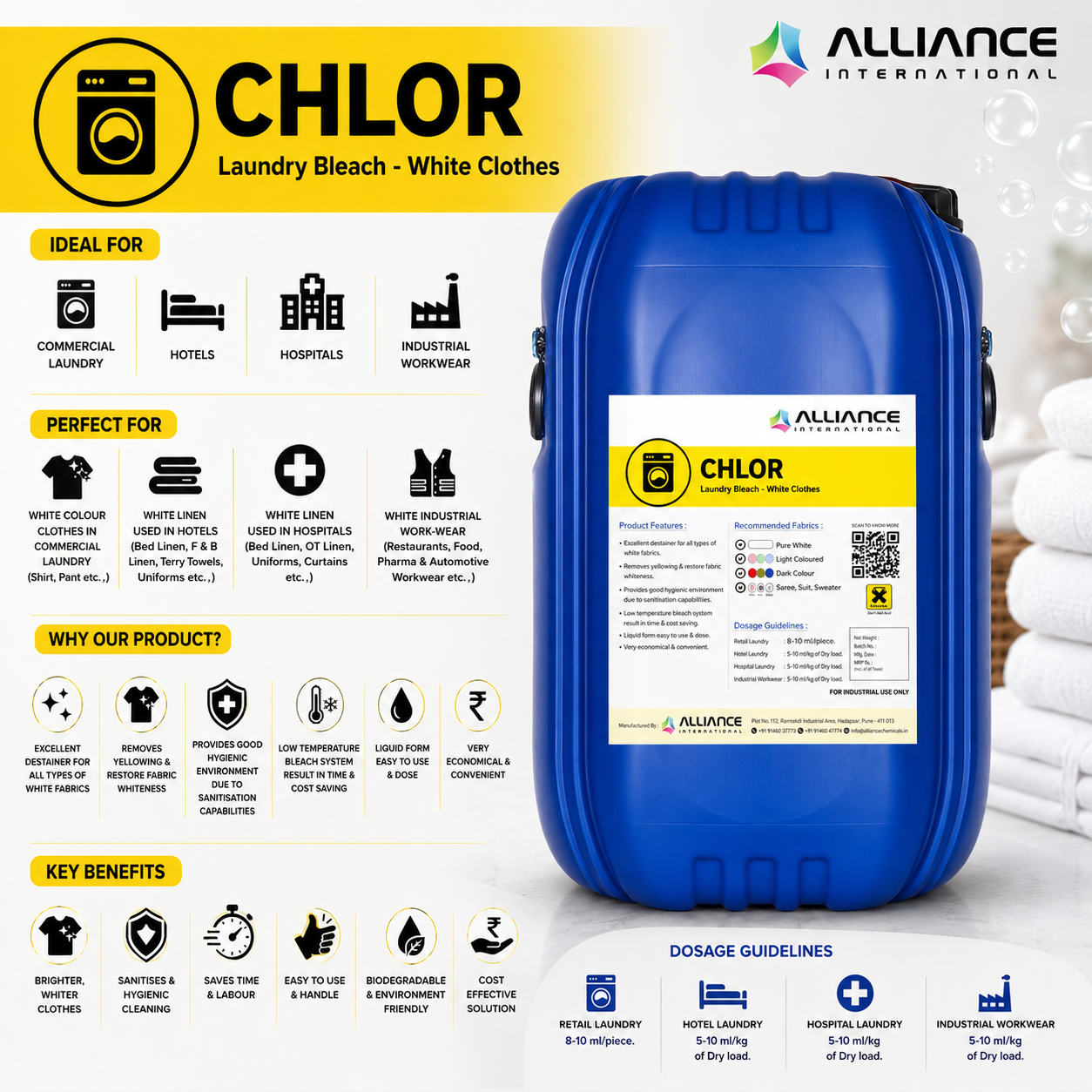 | Bleaches ₹3000 Alliance's CHLOR is low temperature laundry bleach based on hypochlorite & alkali. View product → |
What evidence supports a final go or no-go decision?
Approve the product only when you can identify the exact formulation and every garment-care label permits its treatment. The written wash formula must state dose, temperature, exposure time and rinse controls, and a production-equipment pilot must show acceptable shade, fabric or seam strength, stretch recovery and residual-chemical results.
That is the minimum evidence for delicate healthcare laundry bleach in pune, not a generic “bleach is safe” statement.
- Record the formulation, active chemistry, concentration, textile restrictions and process limits for the Pune supply lot.
- Reject it if any garment label excludes the treatment, including chlorine-sensitive fibres, coatings, prints or trims.
- Reject it if the formula omits the dose, measured bath temperature, contact time, pH, rinse sequence or required neutralisation.
- Reject it if pilot testing finds unacceptable fading, yellowing, strength loss, poor elastane recovery, coating damage or residual chlorine.
- Treat whitening and disinfection as separate claims. Ask whether current evidence supports the intended claim under the relevant standard, such as EN 14476 for virucidal activity or EN 13704 for sporicidal activity; verify the current standard and product documents before deciding compliance.
Do not present the product as a disinfectant, sporicidal process or universal solution for hospital delicate clothes washing problems in Pune without documented validation and qualified infection-control review. If the supplier cannot provide chemistry, concentration, restrictions and process data, reject it and use a separately validated textile-care formula.
Frequently asked questions
What must you verify before using Whitol on hospital textiles?
Identify the exact formulation and Pune supply lot, then check its label, safety data sheet, technical data sheet, dosage, temperature limit, contact time, pH range, storage instructions, and textile-compatibility evidence.
Which healthcare fabrics need exclusion or separate testing?
Exclude or separately test wool, silk, elastane blends, waterproof or coated fabrics, flame-retardant finishes, coloured uniforms, printed textiles, and fabrics with unknown fibre content before routine use.
What wash controls prevent bleach damage and unreliable results?
Control the chemical dose, water temperature, contact time, wash pH, load size, dispensing sequence, rinsing, and neutralisation. Never combine chlorine bleach with acids, ammonia, or incompatible laundry chemicals.
How should you run a Pune pilot before approving Whitol?
Use the exact product lot and normal equipment, test representative fabrics against an approved process, inspect colour, tensile strength, elasticity, absorbency, odour, residue, and whiteness, then repeat after several wash cycles.
What evidence supports a final go or no-go decision?
Keep the product label, batch record, safety and technical data sheets, test plan, wash parameters, photographs, inspection results, rewash findings, operator observations, and signed approval or rejection criteria.
Related product
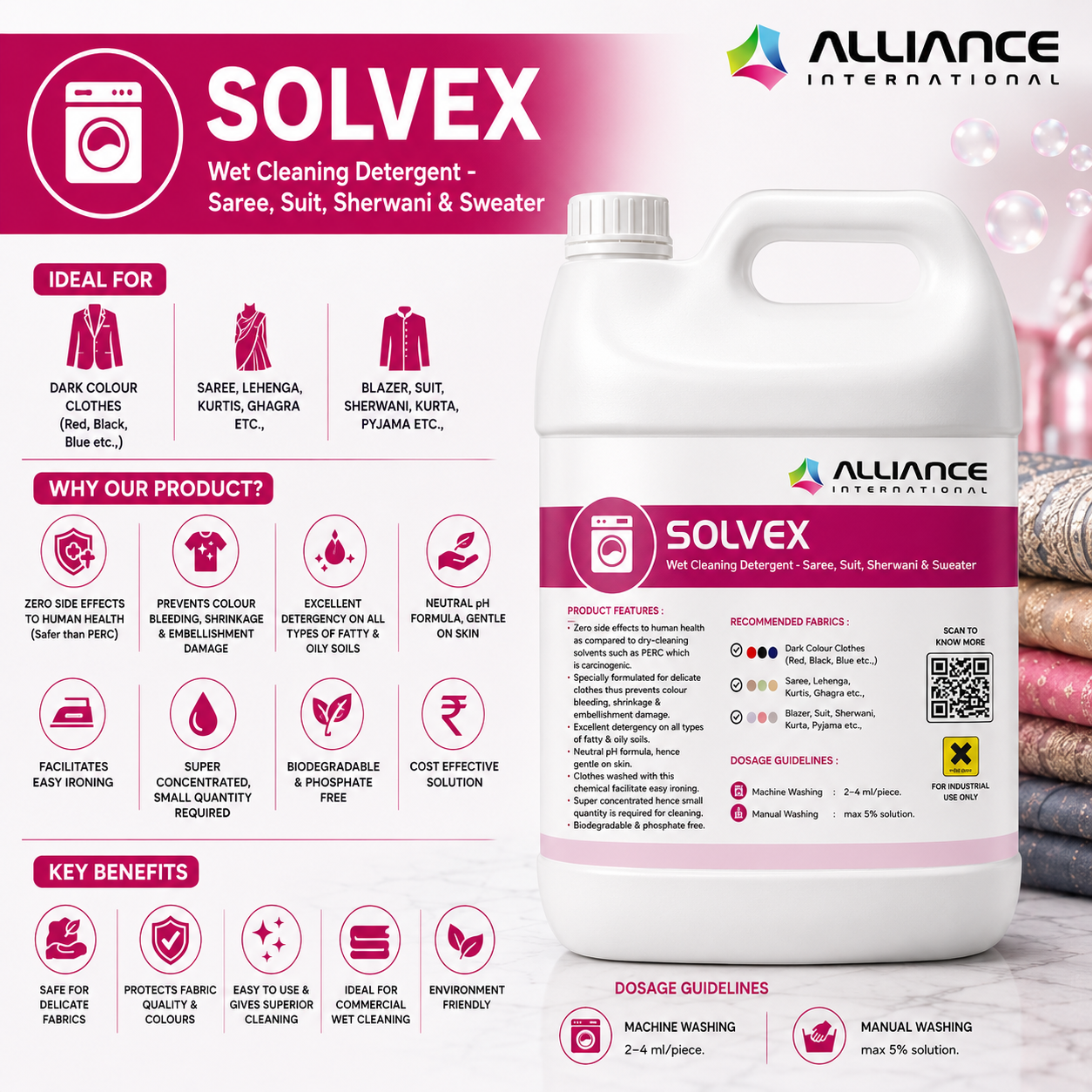 | Detergent Liquids ₹25000 Alliance's SOLVEX is a super concentrated delicate clothes liquid detergent recommended for wet cleaning of clothes found in commercial laundry which... View product → |