
The right liquid depends on the stain chemistry, fibre, dye stability, water quality and washing process—not on whether a product is labelled concentrated or colour-safe. You will be able to match SOLVEX, ULTRA, bleach, an emulsifier or a conventional detergent to specific soils, reject unsafe fabric combinations and compare working cost through a controlled Pune laundry trial.
Key takeaways
- Match solvent spotters to oil, grease, makeup and adhesive residue.
- Use cool water and protease for blood, milk and egg stains.
- Test every product on fabric and colour before full-scale washing.
- Compare working cost per kilogram, not container price alone.
Which liquid matches the stain on white or coloured clothing?
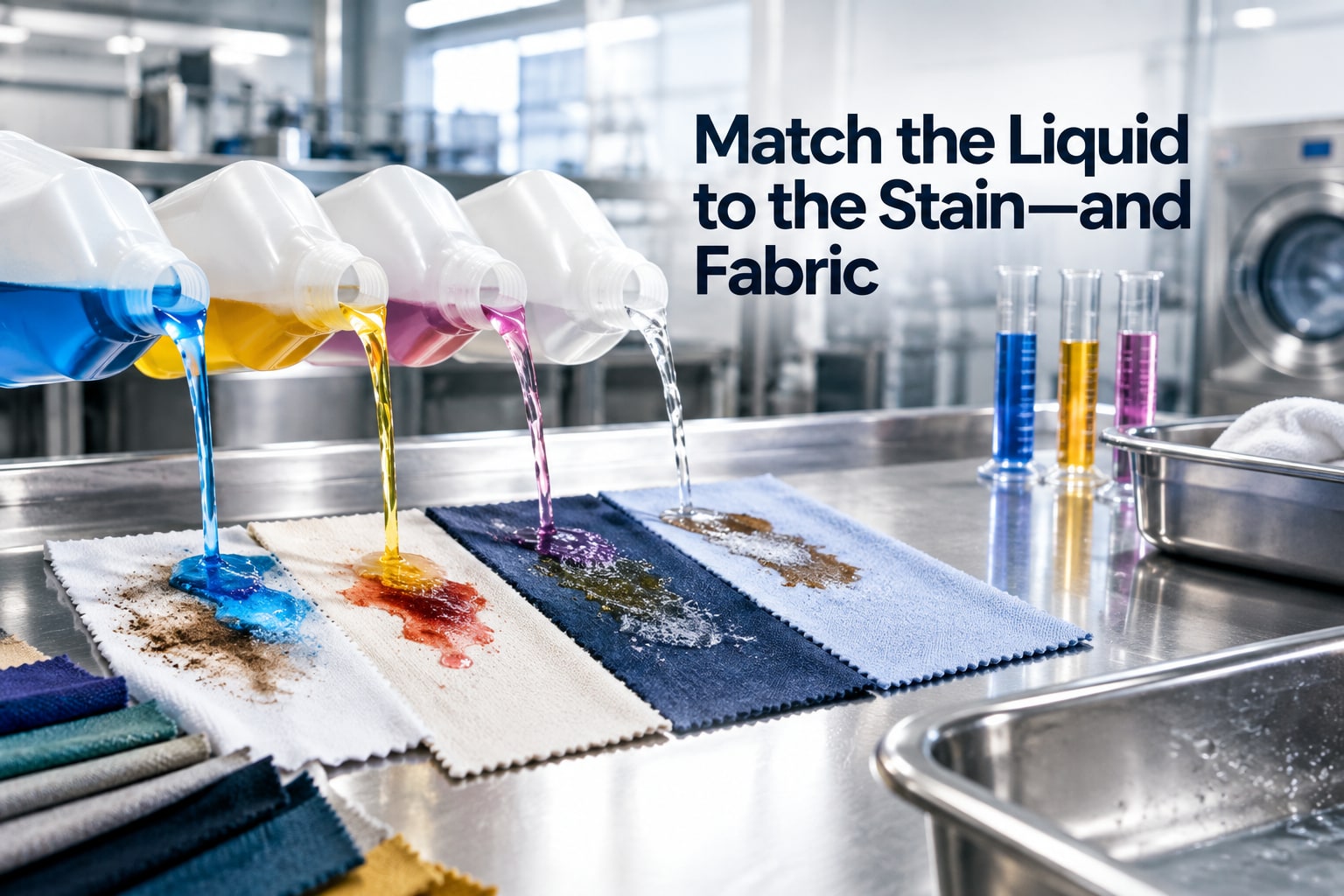
Oil, grease, makeup and adhesive residue point first to a solvent spotter such as SOLVEX; protein, food and mud usually need an aqueous liquid detergent with surfactants, builders and enzymes. Blood, milk and egg need cool water and protease before heat, which can set the stain. Tea and coffee are tannin stains, not ordinary dirt.
Rust needs rust remover chemistry, not stronger detergent.
Stain and fabric decide the liquid:
| Stain class | First choice | Main caution |
|---|---|---|
| Oily: oil, grease, makeup | Solvent spotter, then emulsifier and rinse | Test coloured cotton, polyester and blends; solvent can spread or strip dye |
| Protein: blood, milk, egg | Cool water, protease detergent | Do not begin with hot water |
| Carbohydrate or food | Aqueous liquid detergent, enzyme system | Combination soils need more than one chemistry |
| Tannin: tea, coffee | Detergent followed by an approved oxygen system | Check dye and temperature limits |
| Particulate: mud | Aqueous detergent and builder | Remove loose soil before washing |
| Ink or dye transfer | Controlled spot test and specialist treatment | Stop if colour migrates |
| Rust | Rust-specific remover | Bleach can worsen iron staining |
For solvex or other liquids for white and colour clothing stains in Pune, run a site trial using actual water, temperature, dose and machine conditions. White cotton may accept oxygen bleach after fibre and temperature checks; coloured cotton, polyester and blends need colourfastness testing. Chlorine bleach belongs only on validated white fibres.
A liquid detergent for white clothing stains is enough for routine soil when no oily residue remains; use an emulsifier after solvent spotting when the loosened oil must disperse and rinse away. Never assume a solvent is safe for wool, silk, viscose, elastane or dry-clean-only garments.
Is SOLVEX safe for every fabric and colour?
Do not put SOLVEX into a bulk wash until its current safety data sheet (SDS) and technical data sheet (TDS) identify the active solvent or solvents, surfactants, pH, flash point, VOC content, dilution, textile restrictions and intended use.
| Fabric | Approval requirement | Failure to detect |
|---|---|---|
| White cotton | Confirm wet-cleaning approval; record whiteness and strength | Yellowing, greying or fibre loss |
| Coloured cotton | Test colourfastness and repeated-wash shade change | Dye stripping or bleeding |
| Polyester | Confirm solvent and temperature compatibility | Finish damage or redeposition |
| Cotton-polyester blend | Approve both fibres and the dye system | Uneven shade change |
| Wool | Require explicit wool approval and low-risk process | Felting or shrinkage |
| Silk | Require explicit silk approval; test discreetly | Water marks, loss of handle or colour |
| Viscose | Validate wet strength, temperature and alkalinity | Weakening or distortion |
| Elastane garments | Confirm elastane compatibility and limit heat | Loss of stretch or cracking |
| Coated fabrics | Require coating-specific approval | Delamination or tackiness |
| Dry-clean-only garments | Use only with the labelled process and approved spotter | Permanent marking or finish failure |
“Delicate” or “colour-safe” wording does not cover every fibre, finish, print or unstable dye. A wet-cleaning detergent is not automatically a dry-cleaning spot treatment, and SDS hazard information cannot prove stain-removal performance.
Test an inconspicuous area, then run repeated washes. For a liquid detergent for colour clothing stains, record shade change, multifibre-strip transfer, print bleeding or cracking and elastane damage. For white work, record reflectance or whiteness, greying, yellowing, fabric strength, residual alkalinity and rewash rate.
Treat ULTRA as a main-wash comparison, oxygen bleach as a separate validated oxidation step, and chlorine bleach as a restricted option for approved white fibres only. COLOR-GUARD also needs its TDS dosage, bath order and colour-retention evidence; never assume it is universal.
What wash procedure gives a fair SOLVEX comparison?
A fair solvex liquid comparison in pune uses the same site water, machine, load and drying method for every candidate, not one dramatic stain photograph. Separate whites, stable colours, unstable colours and delicate fibres; do not claim mixed-load performance without evidence.
- Identify each item, inspect its care label, seams, prints, coatings and metal or plastic trim, then record whether the soil is oil, protein, carbohydrate, tannin, particulate or a combination.
- Test colourfastness on an inconspicuous area. Pre-spot only when the current SOLVEX TDS permits it.
- Run separate loads at the same liquor ratio and load size. Record millilitres per kilogram of linen, bath temperature, pH, alkalinity, water hardness, iron, machine type, wash time and dose.
- Take the SOLVEX concentration and maximum temperature for delicate garments from the current TDS or a supplier-approved trial protocol. Never invent a universal millilitres-per-kilogram dose.
- Rinse using the same rinse count, extract at the same speed, and dry by the same method.
- Inspect every load under consistent light and record stain removal, shade change, residue, greying and fabric damage.
Use ISO 6330 as the controlled-washing reference, documenting deviations for professional machines. Treat protein stains with cool water before high heat; heat can set them. Excess alkalinity or heat can damage dyes and elastane, while excess detergent increases rinsing demand and redeposition.
A valid comparison records each variable because changing any one can change the result.
How should you compare concentration, performance and working cost in Pune?
A “super concentrated” label proves nothing until you calculate the delivered dose. For each candidate, use: price per litre × millilitres used per kilogram of linen ÷ 1,000. Record spotter, detergent, emulsifier, builder, bleach and finishing chemicals separately.
Measure the result this way:
| Metric | What to record | Why it matters |
|---|---|---|
| Dose | Millilitres per kilogram | Exposes inflated concentration claims |
| Chemical cost | Cost per kilogram of linen | Compares actual spend, not container size |
| Process demand | Water use, wash time, rinse count and drying time | Reveals labour and utility costs |
| Outcome | Stain removal, rewash percentage and chemical consumption | Captures failures hidden by a low dose |
| White work | Reflectance or whiteness, greying, yellowing, residual alkalinity and fabric-strength concerns | Separates brightness from fibre damage |
| Colour work | Repeated-wash shade change, multifibre dye transfer, print bleeding, elastane damage and absorbency | Detects colour loss and wear after cleaning |
A lower dose is not cheaper if it leaves oily rings, transfers dye, demands a second wash or increases rinsing and drying. Run the solvex liquid comparison in Pune using the actual water supply, hardness, alkalinity, iron, liquor ratio, machine programme and drying temperature; soft-water laboratory results do not transfer directly to a Pune laundry.
For solvex or other liquids for white and colour clothing stains in Pune, request a controlled site trial and current technical data review. ALLIANCE INTERNATIONAL can help structure that comparison, but acceptance must come from your own production records, not concentration language.
Related products
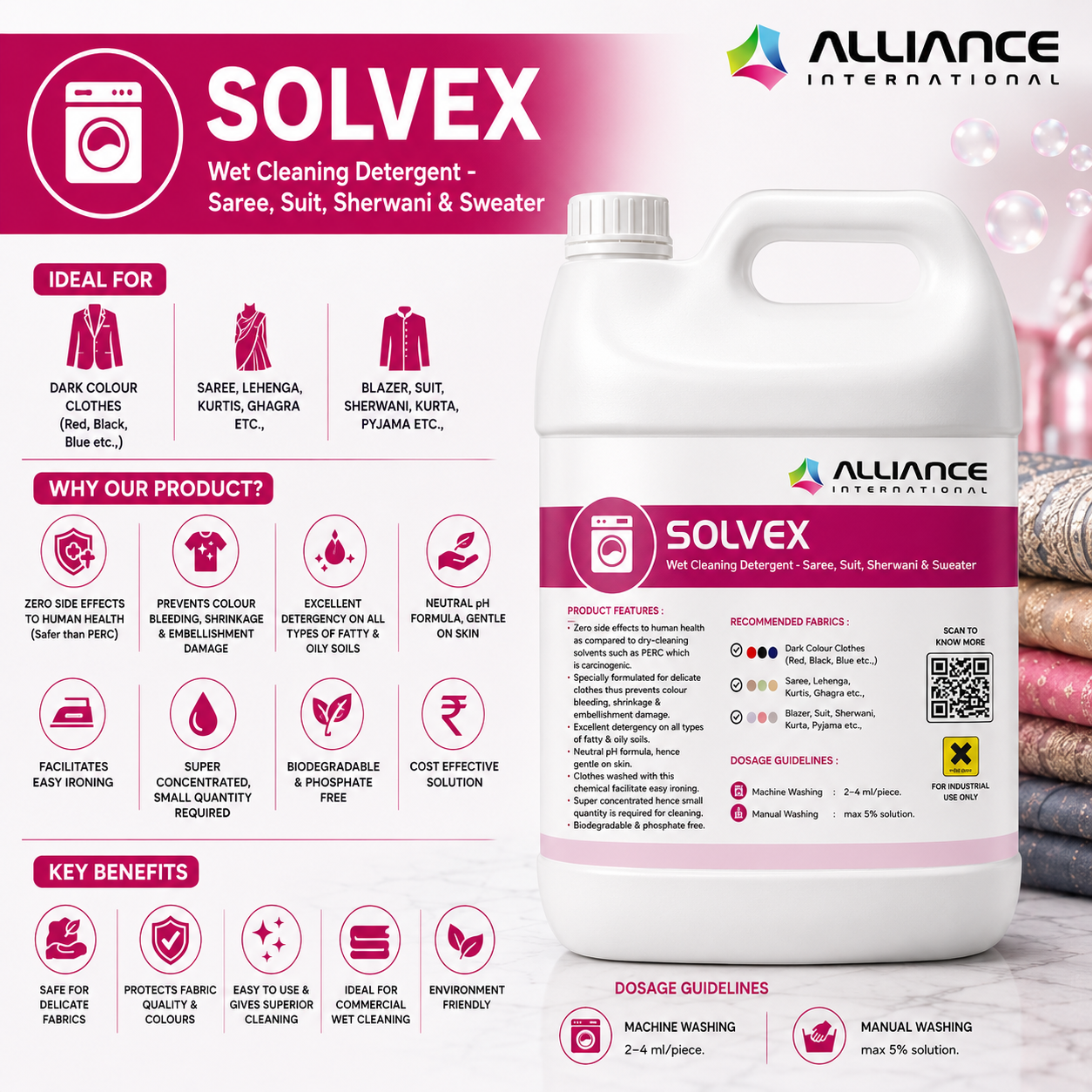 | Detergent Liquids ₹25000 Alliance's SOLVEX is a super concentrated delicate clothes liquid detergent recommended for wet cleaning of clothes found in commercial laundry which... View product → |
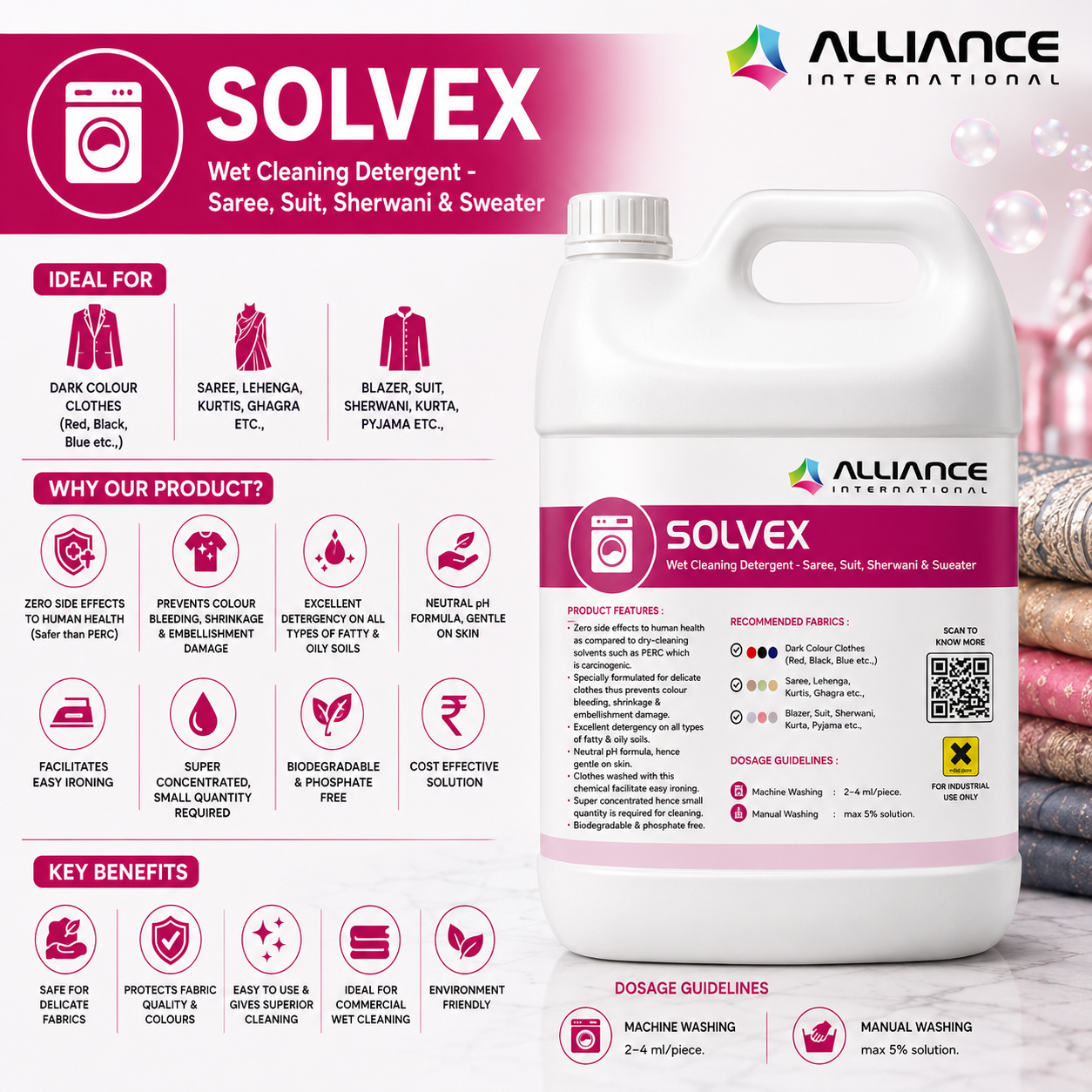 | Detergent Liquids ₹15000 Alliance's SOLVEX is a super concentrated delicate clothes liquid detergent recommended for wet cleaning of clothes found in commercial laundry which... View product → |
When should you choose SOLVEX, ULTRA, bleach or another liquid?
Choose SOLVEX only when its current TDS confirms the required fibre, soil class, wet-cleaning process, dilution, temperature and machine conditions. Approve it after a controlled trial confirms colour retention and residue removal.
| Option | Best choice when | Do not assume |
|---|---|---|
| SOLVEX | Oily, adhesive or cosmetic soil needs solvent action | Extra product improves cleaning |
| ULTRA | Main-wash performance matches the site | Soft-water results predict hard-water behaviour |
| Oxygen bleach | Validated white-work or permanent-colour loads | Optical brightener removes stains |
| Chlorine bleach | Explicitly approved white-fibre loads | It is suitable for coloured stains |
| Liquid detergent | Routine water-soluble or particulate soil | A solvent step is necessary |
| Emulsifier | Oily or solvent-treated soil needs dispersing and flushing | Spotting is complete without the TDS process |
For liquid detergent for white clothing stains, measure soil removal separately from whiteness: record reflectance, greying, yellowing, residual alkalinity and rewashes. For liquid detergent for colour clothing stains, record repeated-wash shade change and dye transfer. Oxygen bleach still requires fibre, dye, temperature and main-wash validation; optical brightener only changes perceived whiteness.
Never mix chlorine bleach with acids or ammonia.
Approve the chosen liquid only after checking:
- Fabric, dye and stain class
- Current TDS and SDS
- Dose, pH, temperature and water hardness
- Rinse result and residue
- Repeated-wash appearance
- Cost per kilogram
That checklist prevents one liquid from being treated as universally superior.
Frequently asked questions
Which liquid matches stains on white or coloured clothing?
Use a solvent spotter such as SOLVEX for oil, grease, makeup and adhesive residue. Use an aqueous detergent with surfactants, builders and enzymes for protein, food and mud. Treat blood, milk and egg with cool water and protease before heat. Tea and coffee need tannin-focused treatment.
Is SOLVEX safe for every fabric and colour?
No liquid is automatically safe for every fabric and colour. Check the product instructions, identify the fibre and dye, then test an inconspicuous area for colour change, bleeding, ring formation or fabric damage.
What wash procedure gives a fair SOLVEX comparison?
Use the same fabric swatches, stain age, dosage, water temperature, wash time, mechanical action and drying method. Record stain removal, whiteness, colour change, fabric feel and rewashing requirements.
How should you compare concentration, performance and working cost in Pune?
Compare active concentration, recommended dosage and cost per kilogram of textiles. Include water, labour, energy, rewashing and fabric-replacement costs, rather than comparing pack prices alone.
When should you choose SOLVEX, ULTRA, bleach or another liquid?
Choose SOLVEX for suitable oily or adhesive stains, ULTRA when its formulation matches the soil and fabric, and bleach only when the fibre, dye, dosage and care label permit it. Use another liquid when testing shows better safety or lower working cost.
Related products
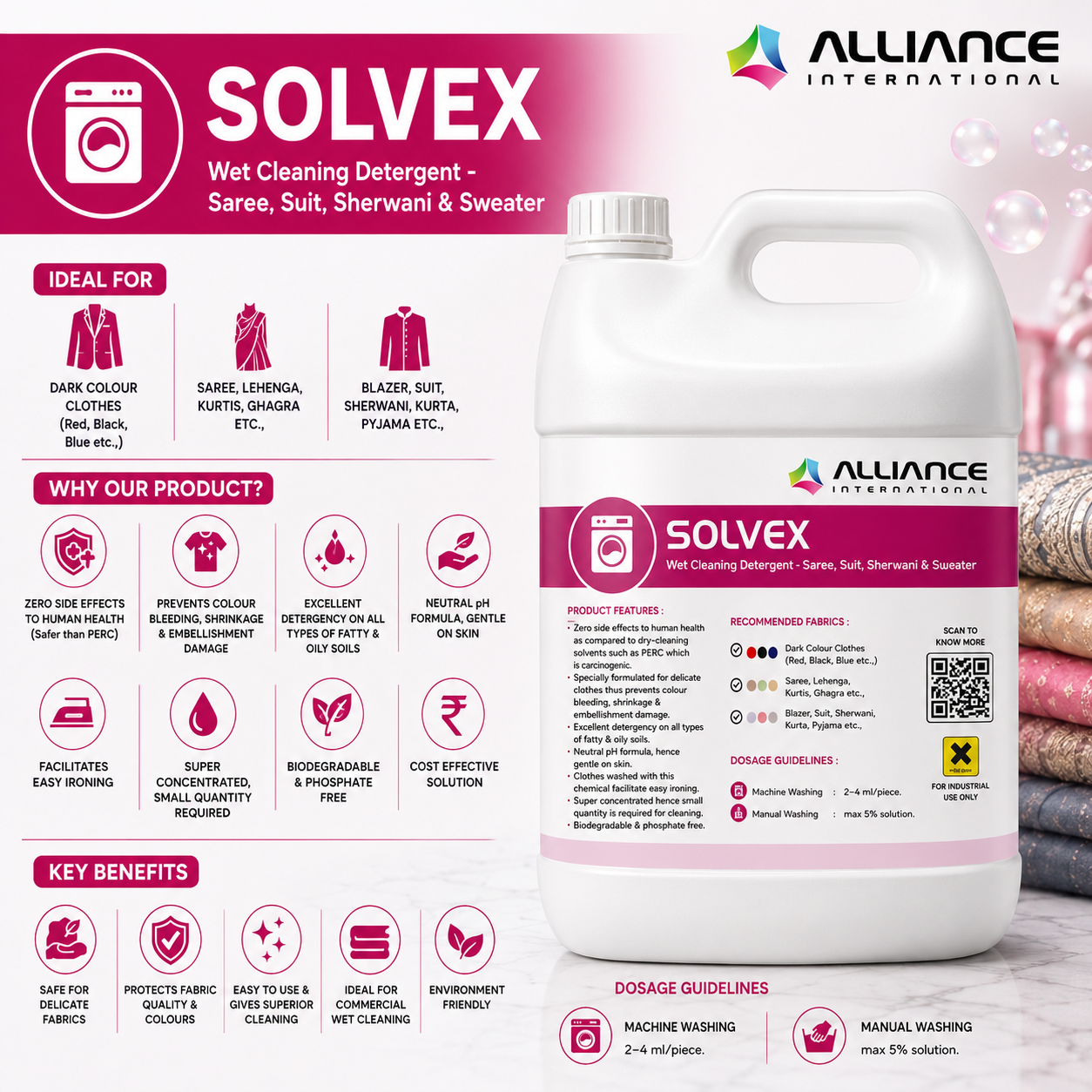 | Detergent Liquids ₹4000 Alliance's SOLVEX is a super concentrated delicate clothes liquid detergent recommended for wet cleaning of clothes found in commercial laundry which... View product → |
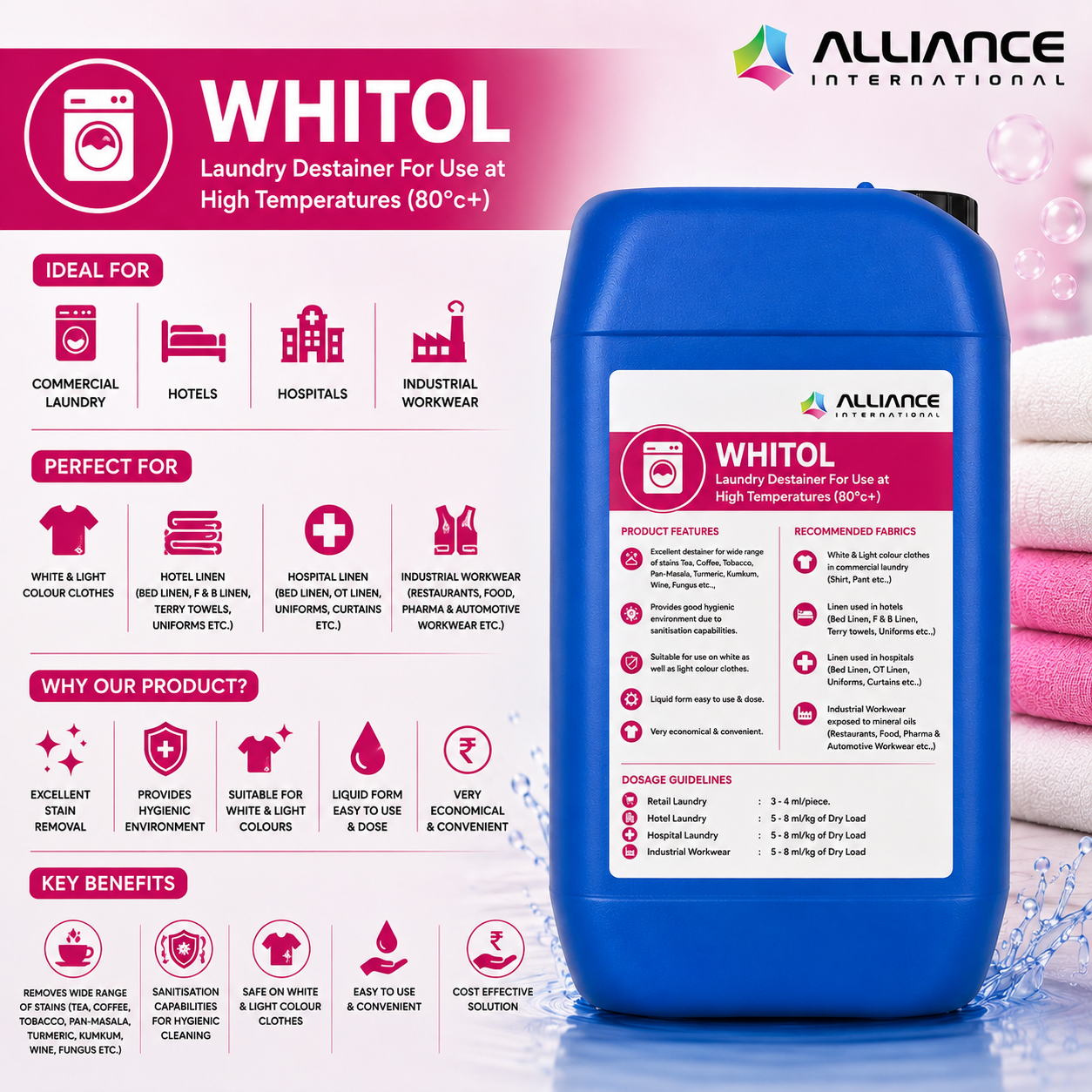 | Bleaches ₹7000 Alliance's WHITOL is a high temperature laundry detainer based on oxygen bleaching agents. View product → |
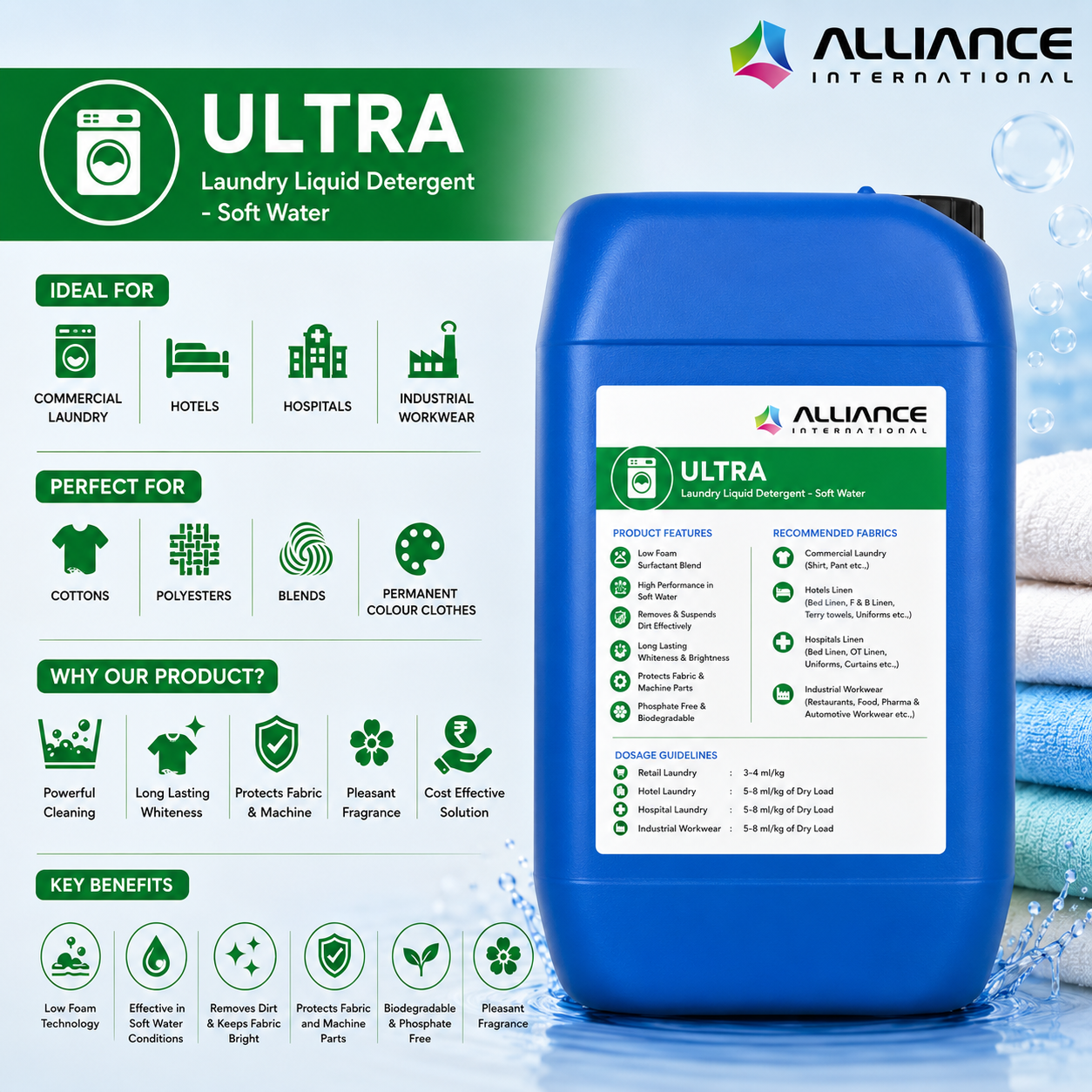 | Detergent Liquids ₹8500 Alliance's ULTRA is an advanced laundry liquid detergent recommended for mainline washing of all types of permanent colour clothes of cottons,... View product → |
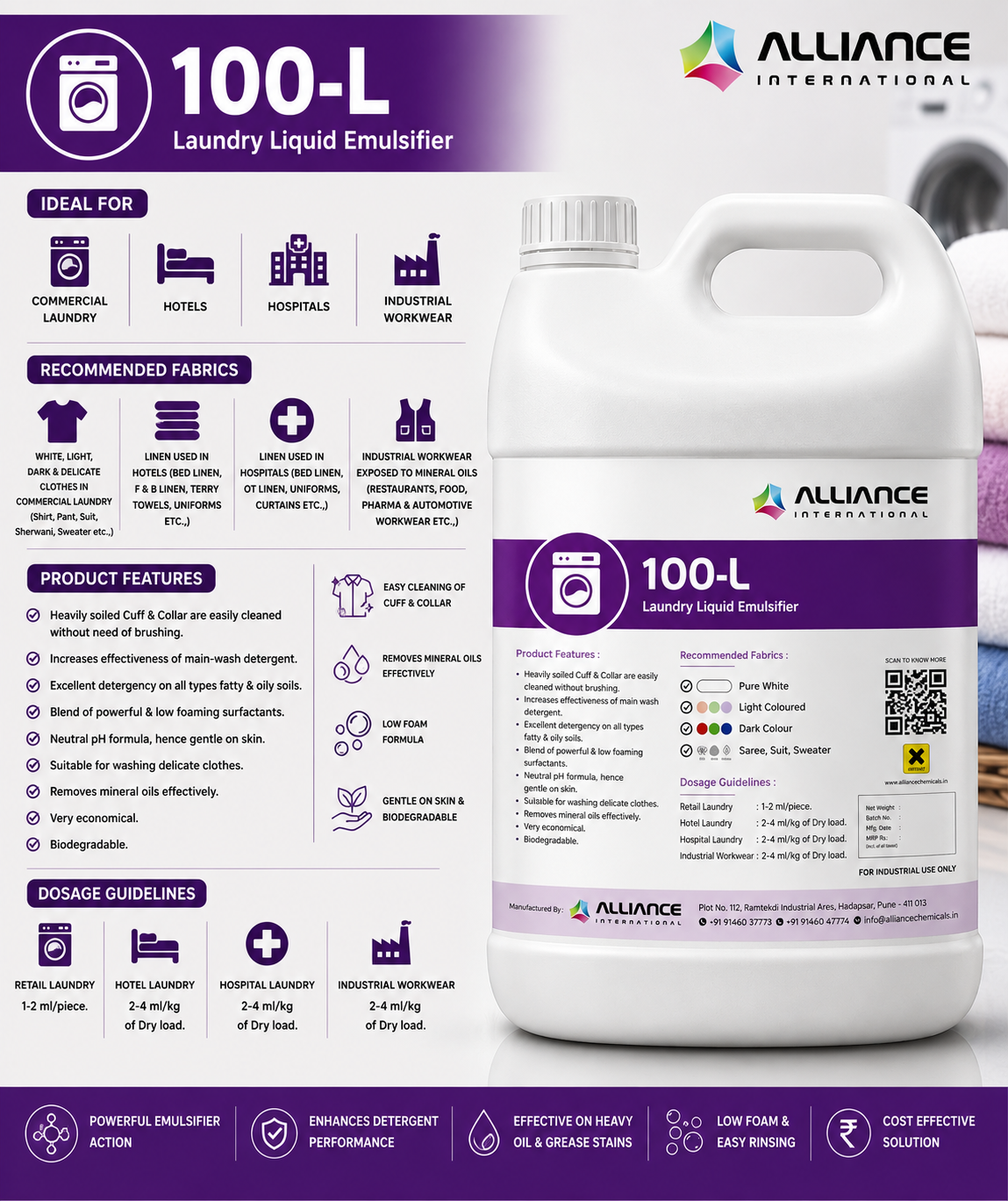 | Emulsifiers & Boosters ₹15000 Alliance's 100-L is a specially formulated laundry liquid emulsifier used along with main-wash detergent to assist in the removal of heavy soils... View product → |