

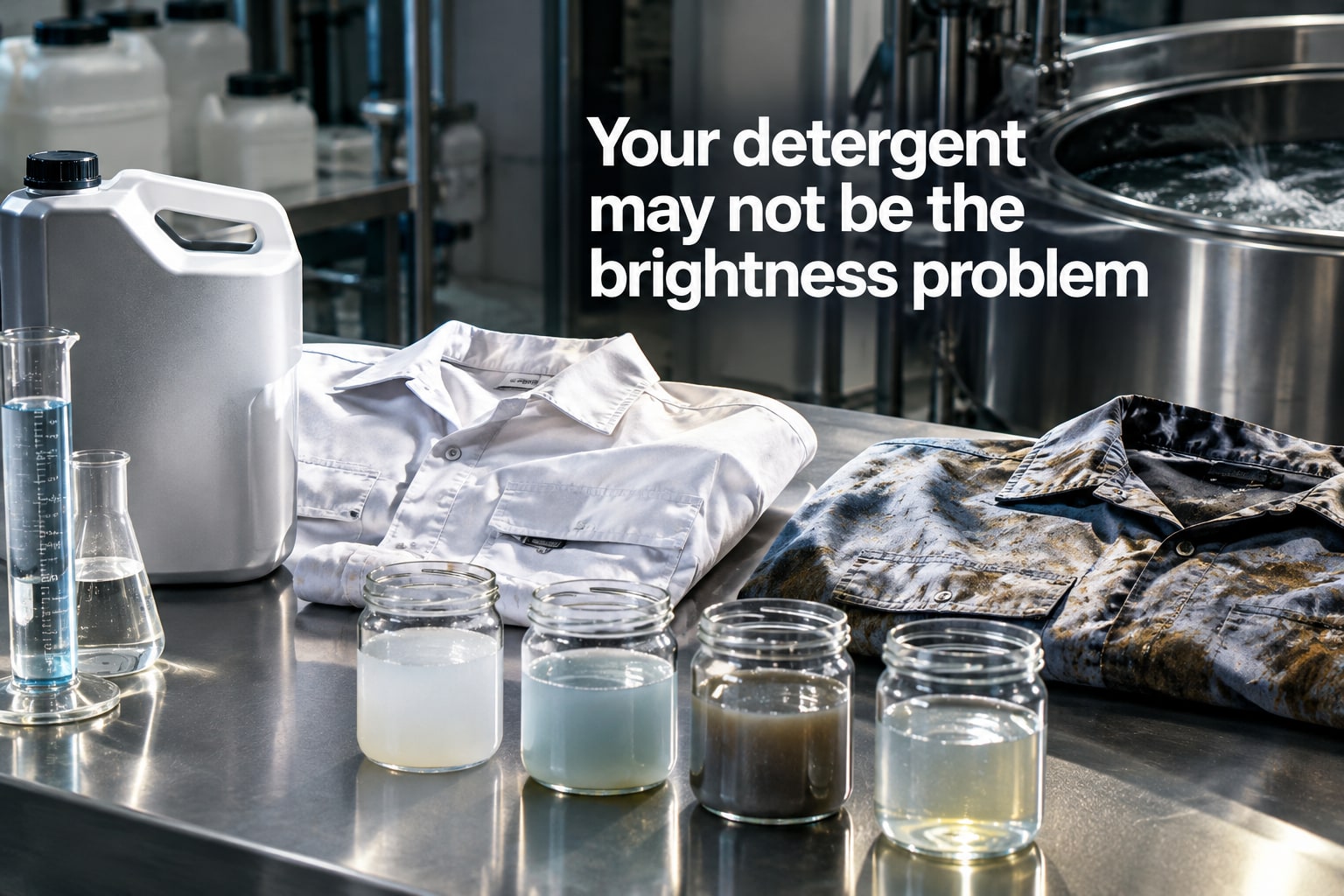
Grey or dull laundry does not prove that your detergent is failing. By testing Mumbai water, separating cleaning from bleaching and finishing, and comparing matched wash loads at cost per kilogram, you can decide whether PRIME is appropriate or another detergent and process will perform better.
Key takeaways
- Test hardness as mg/L as CaCO₃; TDS alone cannot diagnose hard water.
- Compare active chemistry, dosage and wash results instead of pack size.
- Trial detergents on identical Mumbai workwear loads under controlled conditions.
- Calculate detergent cost per kilogram washed, then check bleach and rinse performance.
Test Mumbai water before blaming the detergent
A water report is the quickest way to test whether Mumbai hardness is making clean fabric look grey. Record total hardness as mg/L as CaCO₃, alkalinity, pH, iron and manganese; TDS is not a hardness measurement. Test the incoming water at each site, because supply and storage tanks can change the result.
- Collect a cold-water sample before detergent or softener contact and send it to a laboratory, or use a titration kit that reports hardness as CaCO₃.
- Classify the result: below 60 mg/L is soft, 60–120 moderately hard, 120–180 hard, and above 180 very hard. Hardness above 120 deserves a builder and dosing review before you increase detergent.
- Wash matched fabric pieces using the same machine, load ratio, temperature, cycle, dose and rinse sequence. Record whiteness or reflectance, stain removal, residual alkalinity and fabric hand, then check for mineral film, redeposition, foam and undissolved product.
For prime can or another detergent for no brightness in mumbai, use the water result and formulation sheet rather than pack appearance.
| Starting point | Use it when | Check before choosing |
|---|---|---|
| PRIME | Its builder and dose suit your hardness and soil | Residual alkalinity and rinse demand |
| ULTRA | Its technical sheet fits the same process with better validated results | Fabric shade and strength after repeat washing |
| Powder | You need higher alkalinity or oxygen-bleach support | Dissolution, dust, storage and dosing accuracy |
If hardness is high, a suitable builder strategy matters; blind overdosing can leave alkaline residue that also dulls fabric. A clean-looking result must survive reflectance and residue checks, not just visual inspection.
Compare the wash chemistry, not the can size
A liquid detergent for no brightness must be compared by chemistry and verified performance, not by its 5 litre label. Ask for the technical data sheet and safety data sheet: pH, density, recommended dose, active matter or surfactant system, builders, enzymes, optical brightener, storage conditions and compatibility restrictions. “Liquid” identifies the format, not cleaning strength.
For a prime detergent comparison in Mumbai, record these details before pricing the can:
- Water hardness as mg/L CaCO₃, alkalinity, pH, iron, manganese and temperature; TDS does not replace a hardness result.
- Dose in millilitres per kilogram of dry workwear, dosing method, and whether the formula needs a separate oxygen bleach, alkali or sour.
- Soil profile: body oils, food grease, dust, industrial soil and dye-transfer risk.
- Machine load ratio, wash time, temperature, rinse count and required residual alkalinity.
- Cost per kilogram of workwear, including bleach, rewash labour and extra rinsing.
| Candidate | Chemistry to verify | Operating comparison |
|---|---|---|
| PRIME liquid | Surfactants, builders, enzymes and optical brightener; pH and density | Dose accuracy, water compatibility, foam and rinse requirement |
| Another liquid | Same data points, not only claimed whiteness | Compare on identical loads at the same temperature and dose |
| Powder | Alkalinity, oxygen bleach, enzymes and dissolution range | Check residue, dispenser compatibility and fabric-care limits |
Measure pre-wash and post-wash whiteness or reflectance, stain removal, residual alkalinity and fabric hand. A white garment can look dull from redeposition, minerals or optical-brightener loss even when soil removal is adequate. Validate the lowest cost per kilogram without causing residue, shade change or fabric-strength loss.
Run a controlled trial on real Mumbai workwear
Run the candidate and current detergent on matched loads of the same Mumbai workwear, not on two different piles from the laundry. Use identical fabric swatches or garments carrying the same oil, protein, starch and particulate soils, then record results over at least three washes.
Keep these trial conditions identical:
- Machine and load ratio
- Water source and hardness
- Wash temperature, cycle time and mechanical action
- Detergent dose per kilogram
- Bleach, sour and rinse sequence
- Garment age, fabric mix and drying method
Record pre-wash and post-wash reflectance or whiteness values, not just photographs or operator impressions. Also score removal of standardised stains, measure residual alkalinity after the final rinse, and record fabric hand, odour, shade change and any finish damage.
A fluorescent whitening agent can make a shirt emit more blue-violet light and look whiter without removing one gram of soil. Compare oily, protein and starch stains separately: lipase addresses oil, protease addresses protein and amylase addresses starch. Temperature, pH and bleach exposure can change that result.
For an industrial workwear detergent in Mumbai, inspect high-visibility luminance and colour, flame resistance, water repellency, antistatic behaviour and stretch recovery after washing. Stop the trial if the garment-care label or finish supplier’s limit is breached. Choose the product that improves measured cleanliness and appearance without redeposition, foam-related poor action, residue or finish loss.
Choose the PRIME pack by consumption and cost per kilogram
A prime 5 litre can makes financial sense for a trial, low-volume laundry or a site that cannot safely store an opened bulk container. Compare every pack by cost per kilogram of dry textile: product cost per litre × actual millilitres dosed per kilogram ÷ 1,000.
Add bleach, booster, sour and other required chemicals before accepting a cheaper can.
| Option | Makes operational and financial sense | Main risk |
|---|---|---|
| PRIME 5 litre can | Trial batches, low daily consumption, limited storage or uncertain demand | Frequent ordering and higher packaging cost; an opened can may remain exposed |
| PRIME 25 litre can | Steady consumption that justifies fewer deliveries, with space for a sealed working stock | Decanting effort and excess stock if demand falls |
| PRIME 50 litre can | High, predictable consumption, suitable storage and a dosing setup that uses the container efficiently | Tied-up cash, handling weight and contamination or deterioration after opening |
Do not calculate consumption from the pump setting alone. Collect and weigh its output over a timed interval, then record grams of PRIME per kilogram of dry textile; viscosity, temperature and tubing wear can shift volumetric dosing.
Ask ALLIANCE INTERNATIONAL for the technical data sheet and safety data sheet, then confirm the recommended dose before comparing packs.
- Soil redeposition or persistent perfume and alkali residue
- Foam that reduces mechanical action
- Incomplete dosing or dissolution
- Colour change, finish loss or fabric-strength damage
Run the comparison on the same workwear load and include repeat orders, storage space and delivery frequency in the cost.
Related products
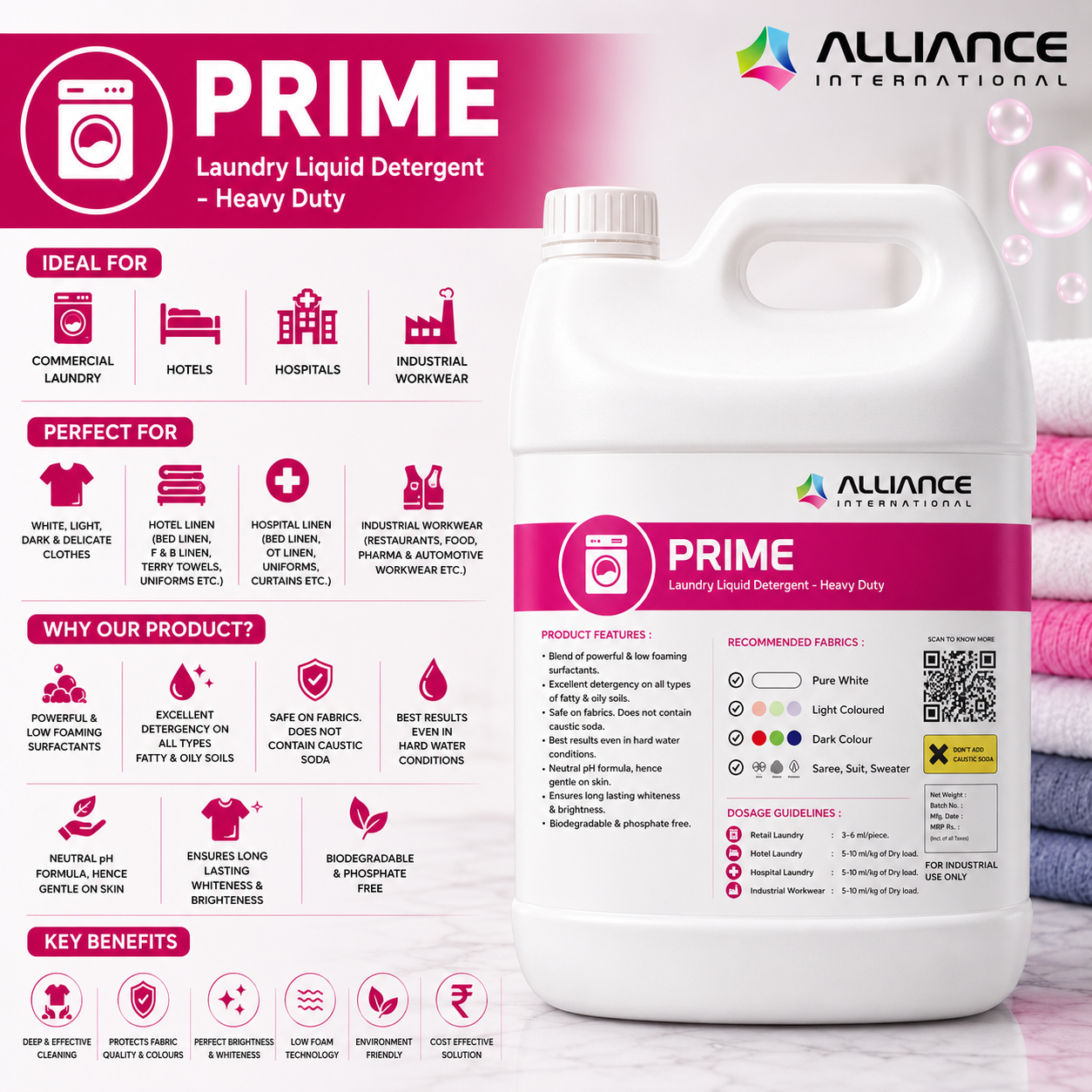 | Detergent Liquids ₹7500 Alliance's PRIME is an advanced laundry liquid detergent recommended for mainline washing of all types of permanent colour clothes of cottons,... View product → |
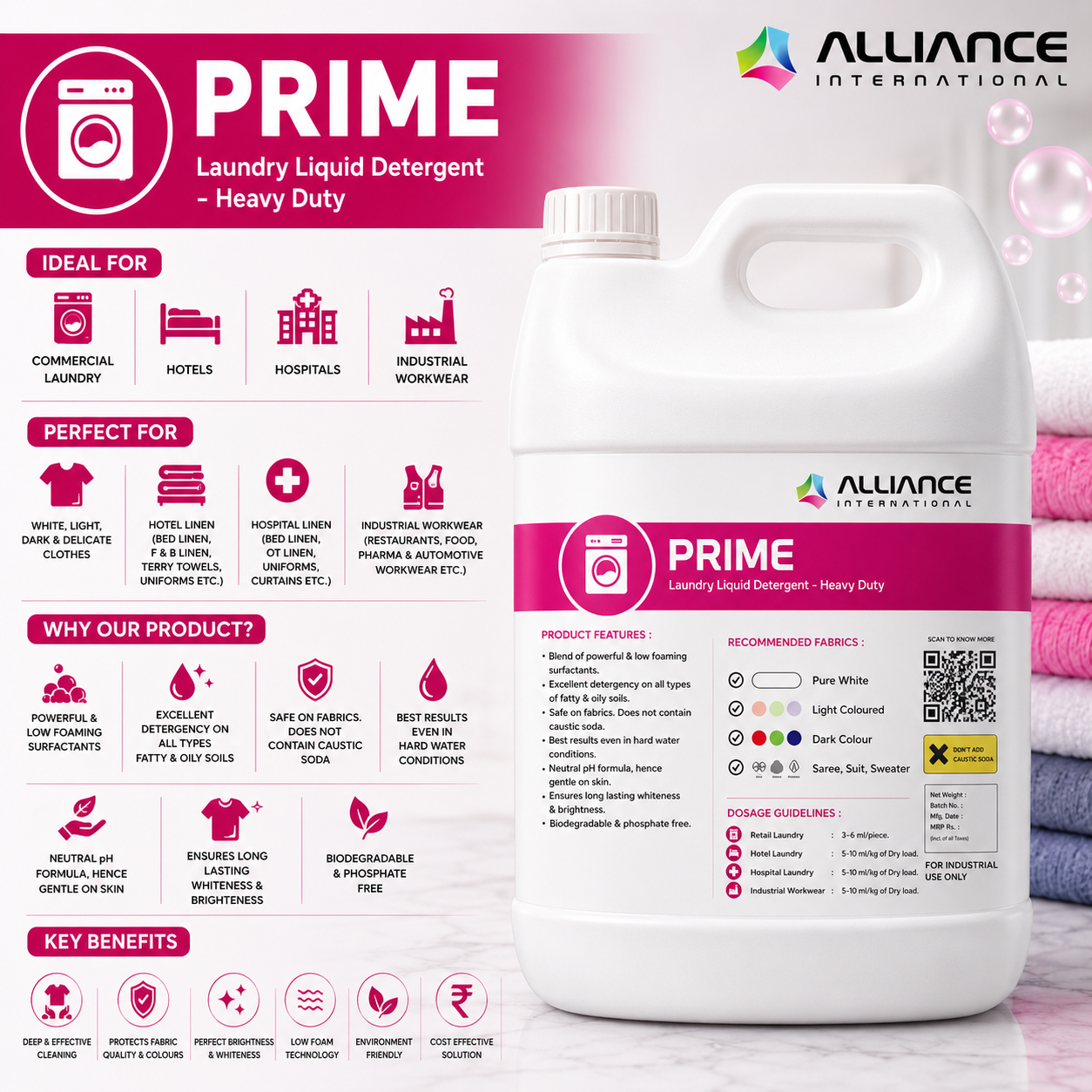 | Detergent Liquids ₹2000 Alliance's PRIME is an advanced laundry liquid detergent recommended for mainline washing of all types of permanent colour clothes of cottons,... View product → |
Separate detergent failure from bleach, rinse and fabric problems
A grey white is not proof of detergent failure. Check whether soil has redeposited, calcium or magnesium has formed a mineral film, optical brightener has been depleted, or the fibre has aged before increasing the dose.
Use this checklist after washing and after drying or ironing:
- Test the final rinse for alkalinity and hardness. A high-pH or mineral-laden rinse points to incomplete rinsing, excessive detergent, or hard-water deposits.
- Inspect the load for foam. Excess foam reduces mechanical action, so garments leave the drum less clean even when the measured dose looks adequate.
- Confirm dosing, dilution and powder dissolution. An under-dose leaves soil behind; an undissolved product or persistent perfume and alkali residue leaves fabric dull.
- Check bleach concentration, temperature, contact time and injection point. Weak bleach leaves whites grey, while excessive or poorly controlled bleach damages fibres and changes coloured shades.
- Compare matched coloured garments for dye transfer and shade change. A detergent that removes soil but strips finish or colour is not a successful choice.
- Record fabric hand, strength and surface finish. Harsh alkalinity, repeated bleaching and heat can make cloth look tired rather than bright.
For a defensible prime detergent comparison in Mumbai, measure pre-wash and post-wash reflectance or whiteness, stain removal, residual alkalinity and fabric hand under identical conditions. That evidence resolves the “prime can or another detergent for no brightness in mumbai” decision more reliably than appearance alone.
Stop increasing detergent when residue is the cause; correct rinsing, bleach or fabric handling instead.
Frequently asked questions
How can Mumbai water affect laundry brightness?
Test incoming water for total hardness as mg/L as CaCO₃, alkalinity, pH, iron and manganese. TDS does not measure hardness, and storage tanks can change site results.
How should you compare Prime with another detergent?
Compare wash chemistry, recommended dosage, water conditions, temperature and measured results rather than comparing can size alone.
How do you run a fair detergent trial on workwear?
Use matching loads of real Mumbai workwear, keep the machine programme and water conditions consistent, and compare brightness, stain removal and fabric condition.
How do you calculate the cost of a Prime 5 litre can?
Convert the pack contents into the number of kilograms washed at the tested dosage, then divide the pack price by that total. Include rewash and chemical costs when comparing products.
Related products
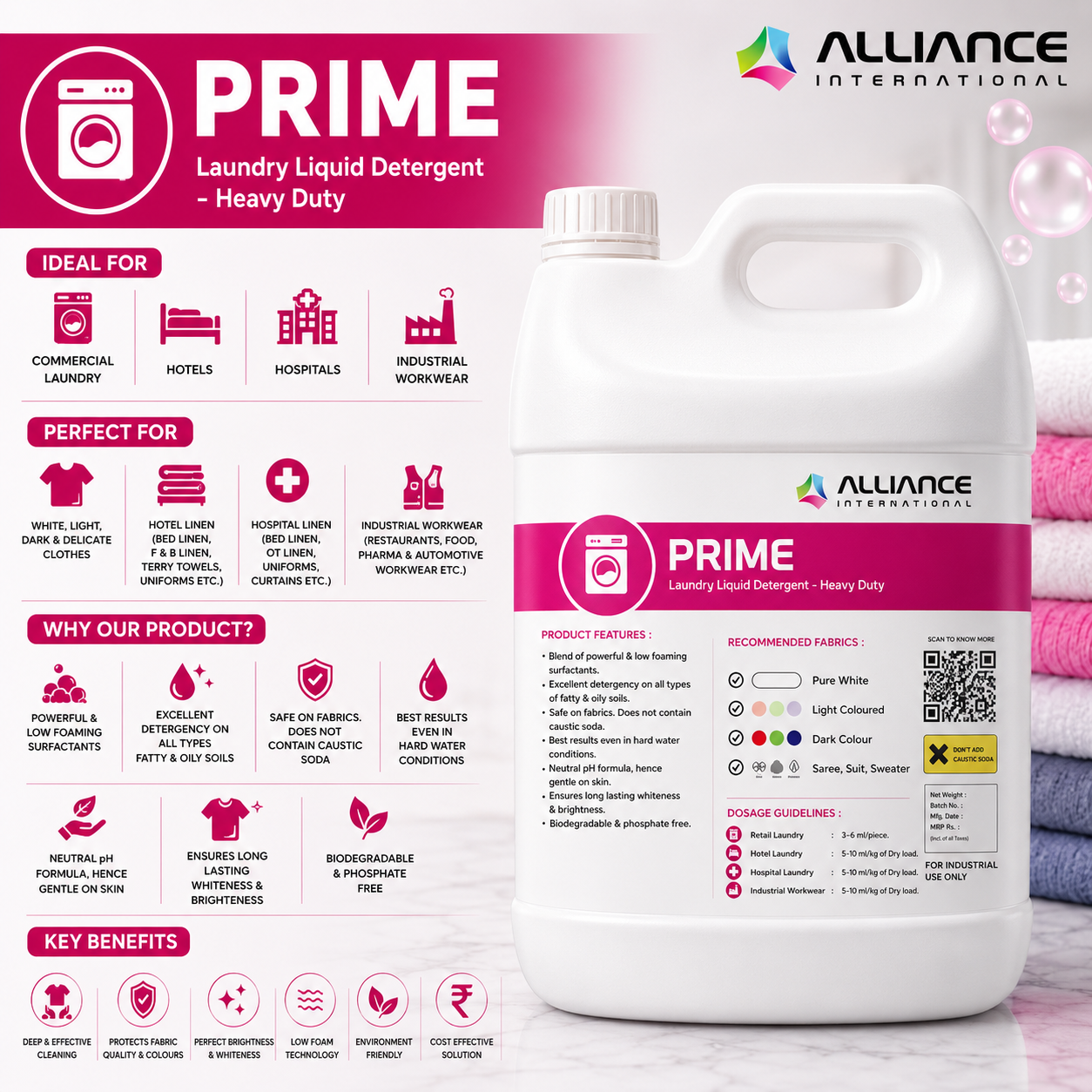 | Detergent Liquids ₹15000 Alliance's PRIME is an advanced laundry liquid detergent recommended for mainline washing of all types of permanent colour clothes of cottons,... View product → |
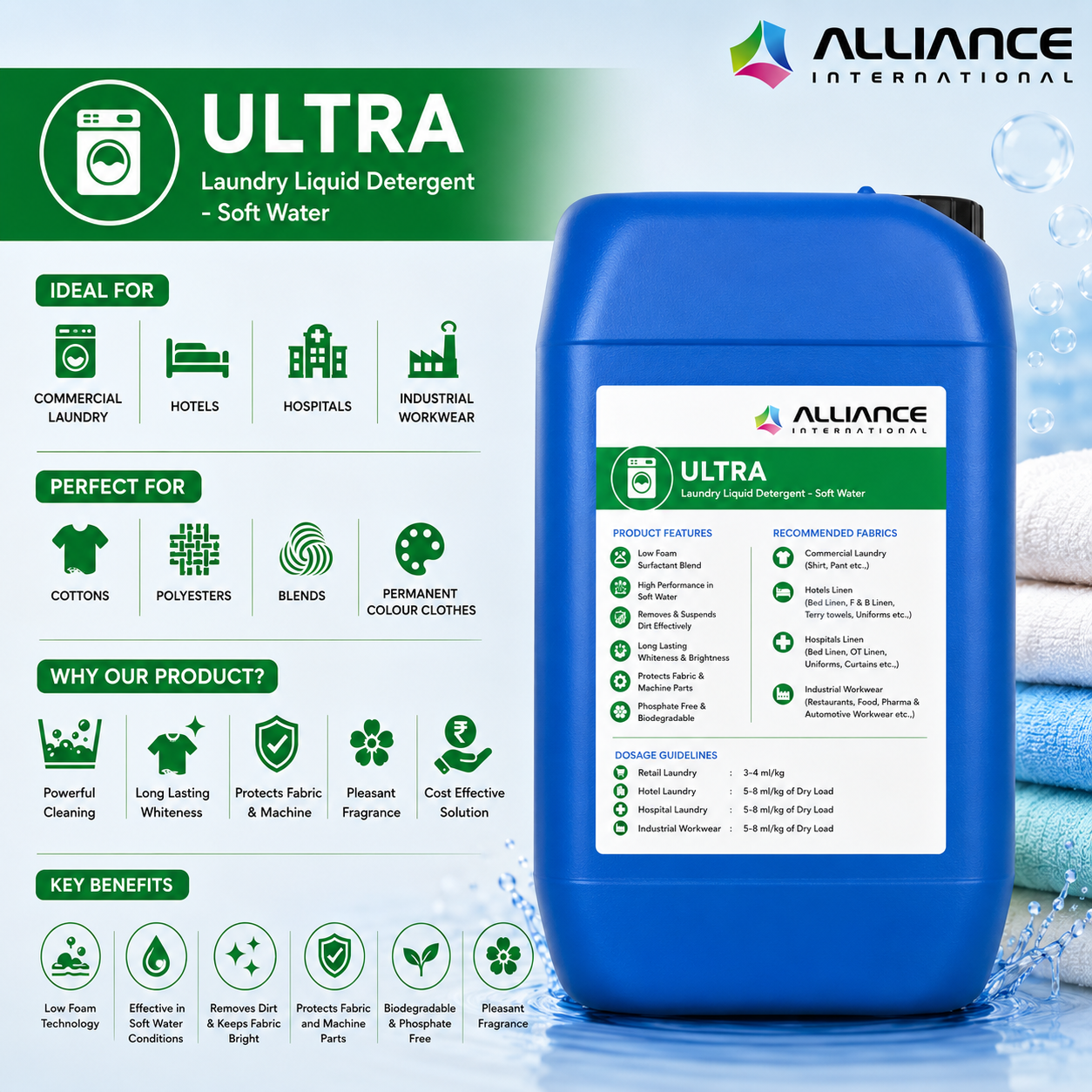 | Detergent Liquids ₹8500 Alliance's ULTRA is an advanced laundry liquid detergent recommended for mainline washing of all types of permanent colour clothes of cottons,... View product → |
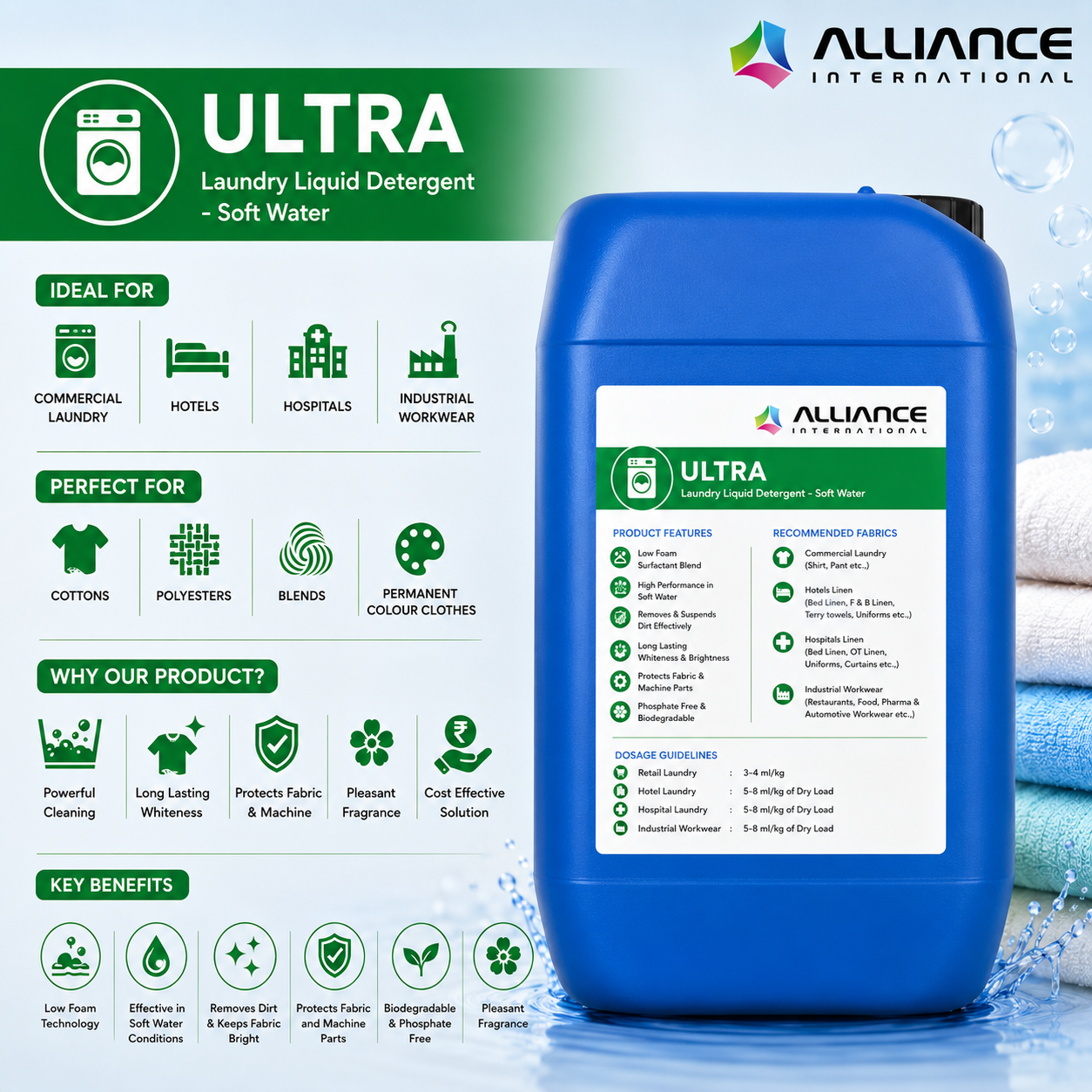 | Detergent Liquids ₹8500 Alliance's ULTRA is an advanced laundry liquid detergent recommended for mainline washing of all types of permanent colour clothes of cottons,... View product → |
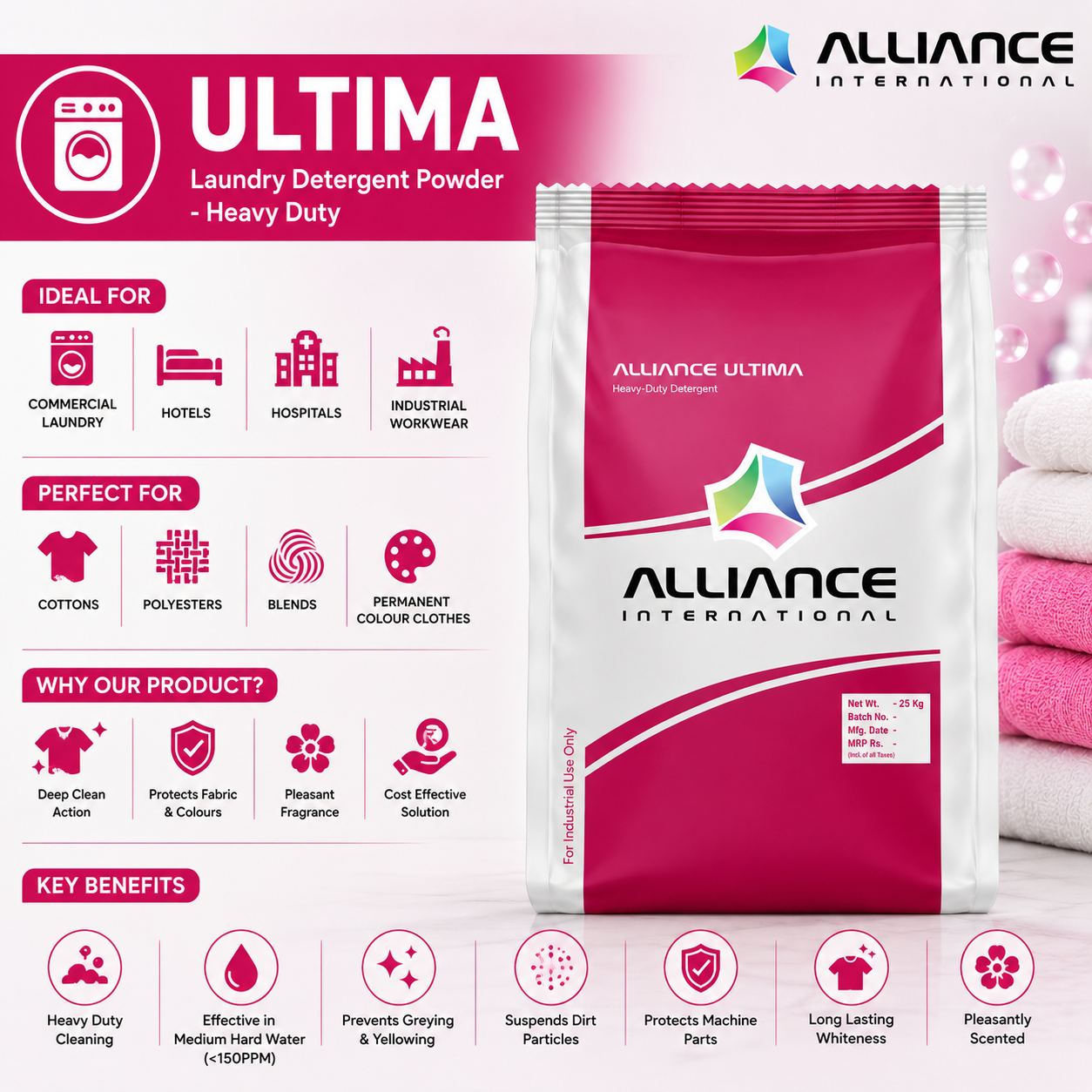 | Detergent Powder ₹7000 Alliance's ULTIMA is a specially formulated heavy-duty detergent powder recommended for main-line washing of all types of permanent colour clothes of... View product → |