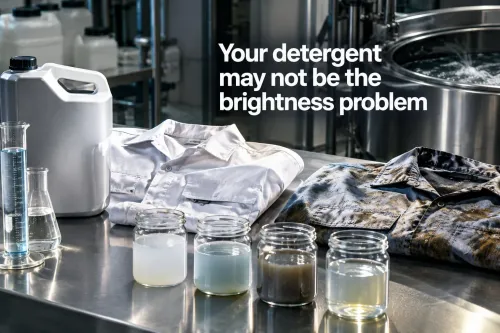

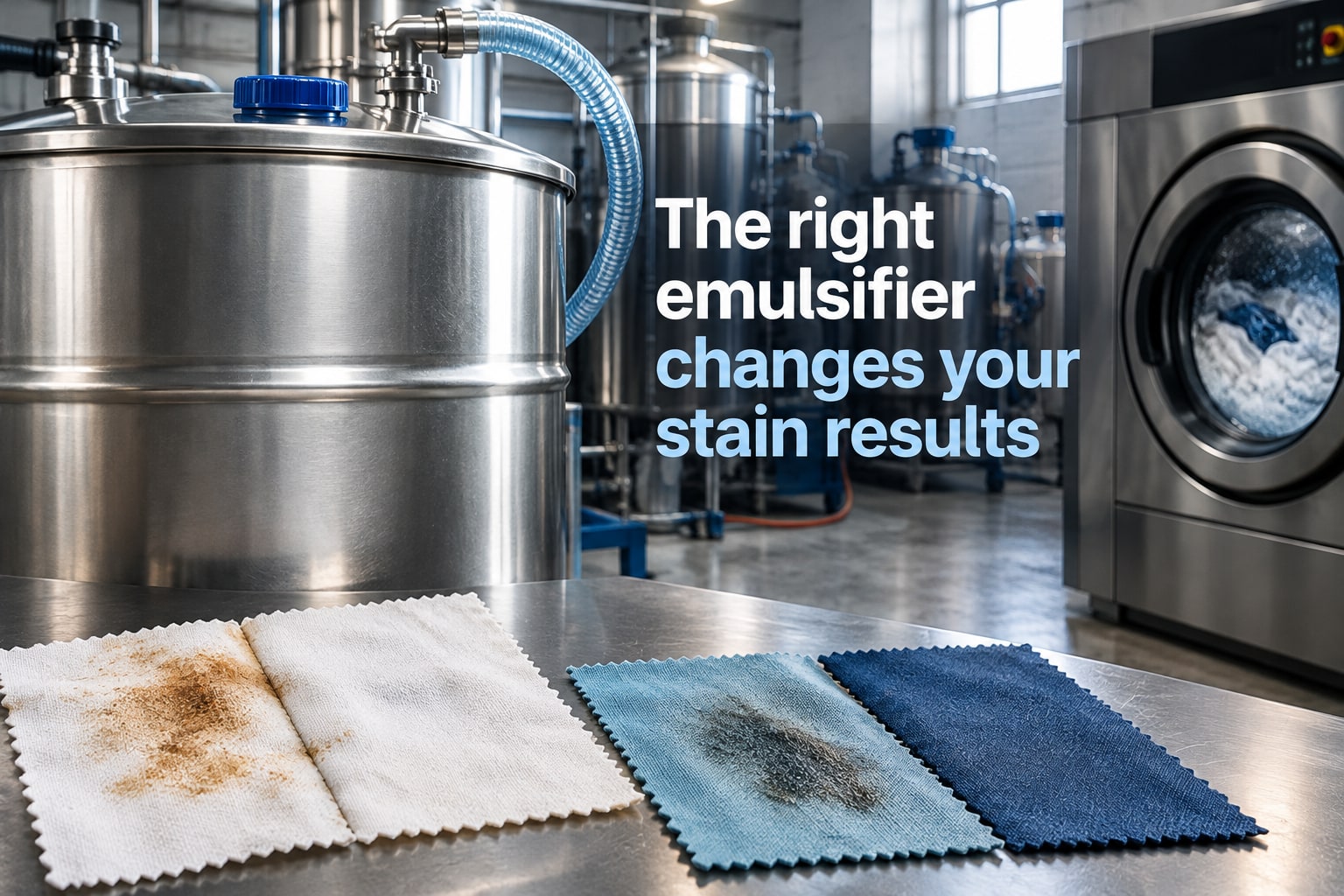
Grease, sebum, cooking fat and oily food soil need different chemistry from rust, dye transfer, tea, blood or mineral scale. By the end, you will be able to identify where an emulsifier fits in a commercial wash, calculate a trial dose, distinguish underdosing from process failure, and decide what evidence to request before buying.
Key takeaways
- Start with a measured trial dose based on liquor volume and soil level.
- Add emulsifier at the wash stage specified by the supplier.
- Separate oily-soil problems from issues caused by temperature, time or rinsing.
- Check the SDS, batch number, storage limits and drum connections before use.
How an emulsifier removes oily soil from textile fibres
An emulsifier removes oily soil by changing how oil behaves in the wash liquor. Its surfactants reduce oil–water interfacial tension, loosen hydrophobic soil from fibres, break it into smaller droplets, and keep those droplets suspended until the wash and rinse water carries them away. The oil is dispersed, not chemically destroyed.
That action suits body sebum, cooking fat, mineral oil, cosmetics, grease, and oily food residue. A 200 l emulsifier for white and colour stain problems can improve oily-soil removal from coloured garments without automatically stripping dye, but colour safety depends on the formulation’s alkalinity, solvent content, temperature, contact time, dye, and textile finish.
The word emulsifier does not mean a complete stain system. Its role differs from these laundry chemicals:
- Detergent: supplies broader soil removal and suspension; an emulsifier targets difficult oil more directly.
- Alkali booster: raises alkalinity to help release soil; it does not provide the same oil-droplet stabilisation.
- Oxygen or chlorine bleach: oxidises stains and affects whiteness; it is not an oil-dispersing treatment.
- Solvent or spot treatment: dissolves or concentrates on selected stains before washing; an emulsifier works through the wash liquor.
- Optical brightener: makes white fabric appear brighter through fluorescence; it does not remove grease.
A 200-litre drum identifies approximate pack volume, not chemical strength or performance. Compare the technical data sheet’s dose per kilogram of dry linen, pH, solvent system, and colourfastness evidence before choosing between products.
Where to add the emulsifier and how to calculate a trial dose
Treat “200 L” as the drum capacity, not the amount for one wash. For 200 l emulsifier laundry use, select the product’s recommended rate for the fabric and soil load, then introduce it into the prewash or main-wash liquor through a calibrated dosing pump.
Do not pour concentrated emulsifier onto dry linen, and do not send it to the final rinse.
1. Confirm the supplier’s unit. A rate of 5 mL/kg means 5 millilitres for each kilogram of dry goods. If the instruction is given in grams per kilogram, use the product density to convert mass into volume. If it is given per litre of wash liquor, first record the machine’s actual liquor volume.
2. Calculate the batch quantity. For 200 kg of dry linen at 5 mL/kg: 5 × 200 = 1,000 mL, or 1 litre of product. At 8 mL/kg, the requirement is 1,600 mL.
3. Convert that quantity to a pump setting. If the pump must deliver 1 litre during a 30-second injection, set the target to 2 L/min, or 120 L/hour. Confirm the result by collecting the discharge for a timed test; the displayed setting is not proof of actual flow.
4. Run a controlled trial at the supplier’s midpoint, then compare oil removal, colour change, redeposition and rinse quality before increasing the dose. Keep detergent, temperature, wash time and liquor ratio unchanged.
Choosing the right treatment for white and coloured textiles
Use an emulsifier for white clothes stains when the soil is body sebum, cooking fat, mineral oil, cosmetics, grease or oily food residue. It will not replace an enzyme, oxygen bleach, chlorine bleach, reducing agent or rust treatment for tea, coffee, wine, fruit pigments, blood or rust.
An emulsifier for colour clothes stains can lift oily soil without stripping dye, but “colour-safe” is not guaranteed by the product name. Alkalinity, solvent content, temperature, exposure time, dye and fabric finish all affect the result.
| Fabric | Treatment change | Main risk to check |
|---|---|---|
| Cotton | Use the supplier’s normal trial dose and wash temperature; increase only after comparing oily-soil removal. | Excess alkali, heat or bleaching can weaken fibres or yellow whites. |
| Cotton blends | Start conservatively and confirm performance on the synthetic fibre, not cotton alone. | Polyester can retain oily soil, while the cotton component may tolerate a harsher process. |
| Dyed linen | Use lower alkalinity, temperature and mechanical action when the care label permits; shorten exposure during trials. | Dye change, fibre swelling and surface abrasion. |
| Permanent-colour goods | Verify the actual dye range before routine dosing; do not assume “permanent” means bleach-proof. | Shade loss and staining on adjacent fabric. |
| Finished workwear | Check water-repellent, flame-resistant, soil-release and reflective finishes with the garment supplier. | The emulsifier or wash conditions can strip a functional finish. |
Test representative garments through repeated laundering. Record shade change and adjacent-fabric staining using AATCC TM61 or ISO 105-C06 where the method matches your claim. A grey cast or dye transfer needs sorting, liquor turnover, detergent control or a dye-transfer inhibitor—not simply more emulsifier.
How to test performance and find the real cause of a failed wash
Run a matched trial: use the same textile mix, soil level, liquor ratio, wash time, temperature, alkalinity, detergent and rinse programme. Compare the current formula with the 200 L emulsifier for white and colour stain problems, changing only its dose.
1. Weigh two equal loads and record the dry-linen weight, water hardness, wash temperature, dosing volume and cycle time. Photograph representative stains before washing.
2. Run the control load without the emulsifier, then run the test load at the supplier’s stated millilitres-per-kilogram rate. Keep the injection point and mechanical action identical.
3. Grade oily marks after drying under consistent light. Record pass rate, rewashes, spotting time and rejected pieces; include a colour-fade check on dyed linen and workwear.
4. Repeat the comparison at the same dose for at least three matched loads. One unusually clean or dirty load can mislead you.
Persistent greasy soil with correct temperature and rinsing points to underdosing, poor injection or inadequate alkalinity. A clean result at a higher dose supports underdosing.
Improvement after raising temperature points to slow soil release, while residue, grey appearance or detergent carryover after a good wash points to insufficient rinsing rather than weak emulsifier for colour clothes stains.
Calculate benefit as labour minutes saved per 100 kilograms, rewashes avoided, kilograms of linen kept in service and product used per kilogram. Stop the trial if dye bleeding, odour, residue or fabric damage appears, even when stain scores improve.
What to verify before buying, storing and connecting the product
Before accepting a 200 L drum, treat 200 L as the pack size, not a strength or performance grade. Two drums can differ in surfactants, solvents, builders, alkalinity and preservatives. Compare cost and dose per kilogram of dry linen, not cost per container.
1. Request the product label, technical data sheet and safety data sheet. Confirm the recommended dose, pH or alkalinity, density, intended prewash or main-wash injection point, storage temperature, shelf life and spill controls. Ask ALLIANCE INTERNATIONAL for these documents before setting up 200 L emulsifier laundry use.
2. Check that the formulation suits your textiles. Require colourfastness or dye-bleed test evidence for coloured goods, and verify performance on cotton, blends and workwear. An emulsifier for white clothes stains targets grease, sebum, oils and cosmetics; it will not replace chemistry for rust, blood, tea or wine.
3. Obtain written compatibility instructions before connecting the drum. Do not combine concentrated product with chlorine bleach, oxygen bleach, acids, solvents or other laundry chemicals unless the label and safety data sheet permit it. Use gloves, eye protection, ventilation, secondary containment and a labelled transfer line.
4. Confirm the pump, tubing and injection point match the product. Calibrate delivery in millilitres per kilogram of linen, prevent contact with dry fabric, and store the sealed drum upright away from heat, freezing and direct sunlight.
Related products
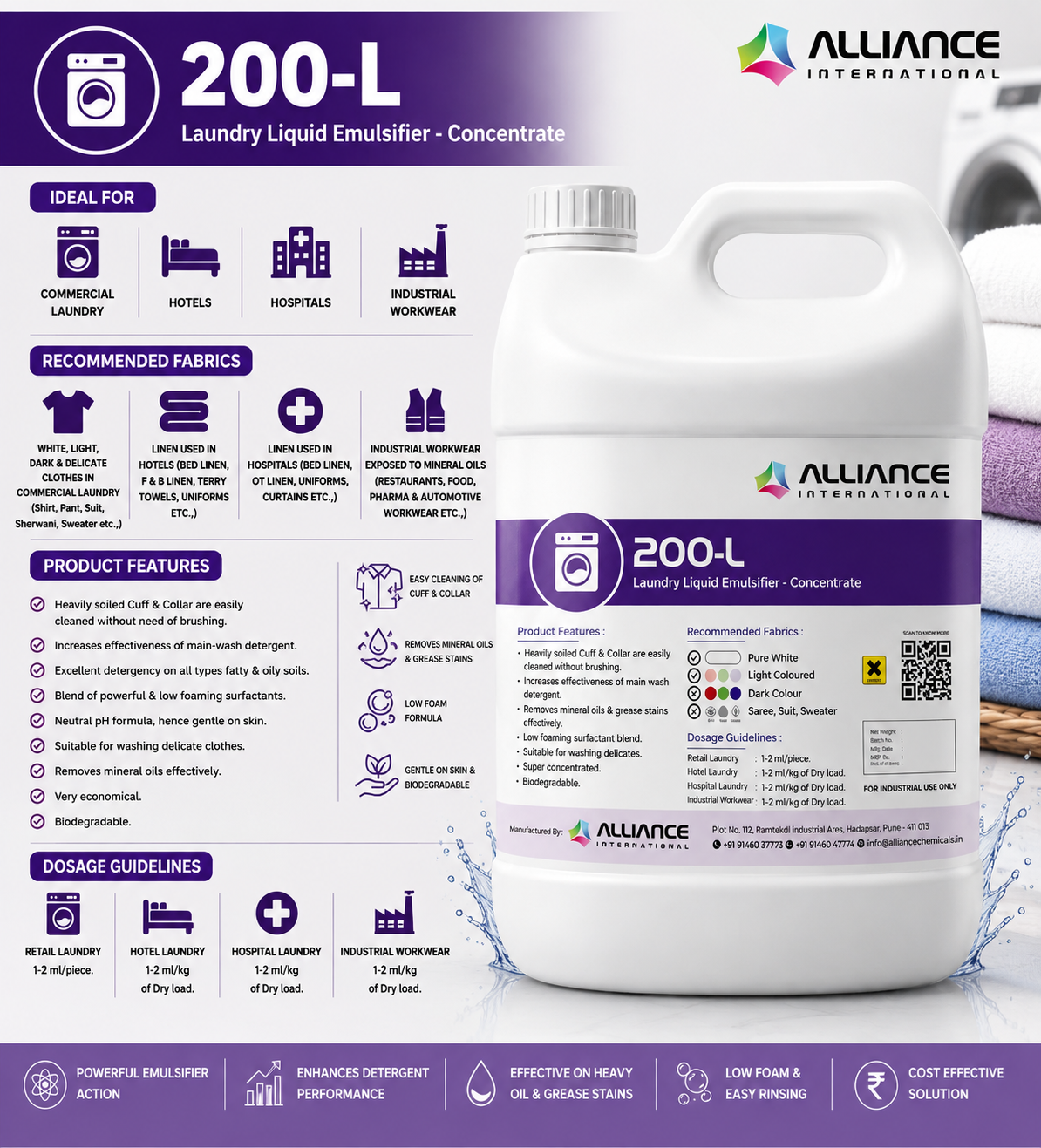 | Emulsifiers & Boosters ₹3500 Alliance's 200-L is a specially formulated laundry liquid emulsifier used along with main-wash detergent to assist in the removal of heavy soils... View product → |
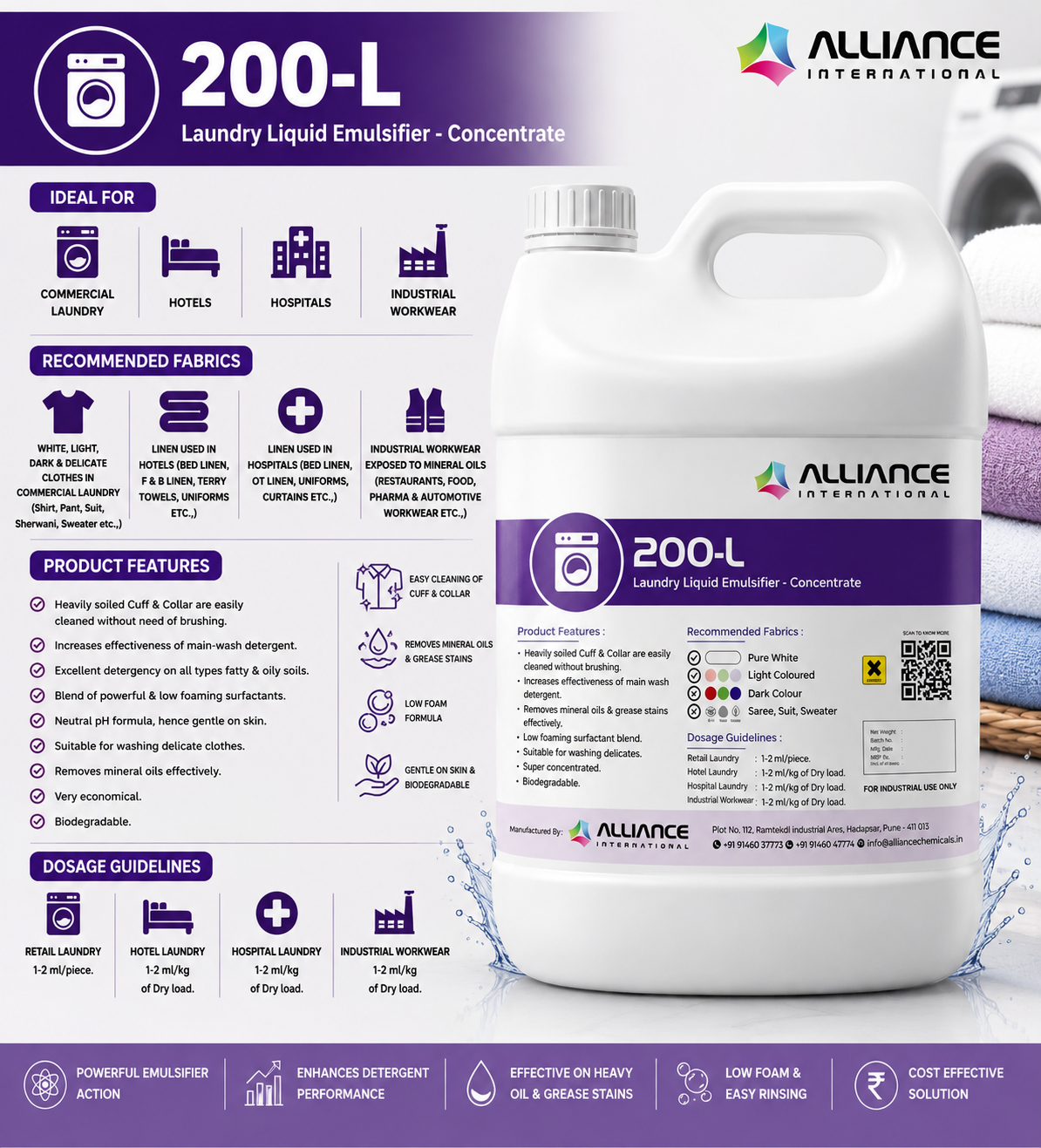 | Emulsifiers & Boosters ₹25000 Alliance's 200-L is a specially formulated laundry liquid emulsifier used along with main-wash detergent to assist in the removal of heavy soils... View product → |
Frequently asked questions
How does an emulsifier remove oily soil from textile fibres?
Its surfactants reduce oil–water interfacial tension, loosen hydrophobic soil, disperse oil into smaller droplets and keep it suspended until washing and rinsing remove it. The oil is dispersed rather than chemically destroyed.
Where should you add a 200 L emulsifier, and how do you calculate a trial dose?
Add it through the chemical dosing system or at the wash-stage point specified by the supplier. Calculate a trial dose by multiplying the recommended millilitres per kilogram of dry textiles by the load weight, then record the result and adjust only after checking stain removal and fabric condition.
Which treatment is suitable for white and coloured textiles?
Use a formulation and process approved for the fibre, dye and soil type. White textiles can tolerate treatments that are unsuitable for dyed goods, while coloured textiles need checks for colour loss, bleeding and shade change.
How can you find the real cause of a failed wash?
Check the emulsifier dose, chemical injection point, wash temperature, wash time, mechanical action, water quality, rinse performance and textile loading. Compare results with a controlled trial before changing several variables at once.
What should you verify before buying, storing or connecting a 200 L emulsifier?
Verify the product name, intended textile use, dosage instructions, SDS, batch number, pack seal, storage temperature, shelf life and compatibility with the dosing pump, hose and fittings.
Related product
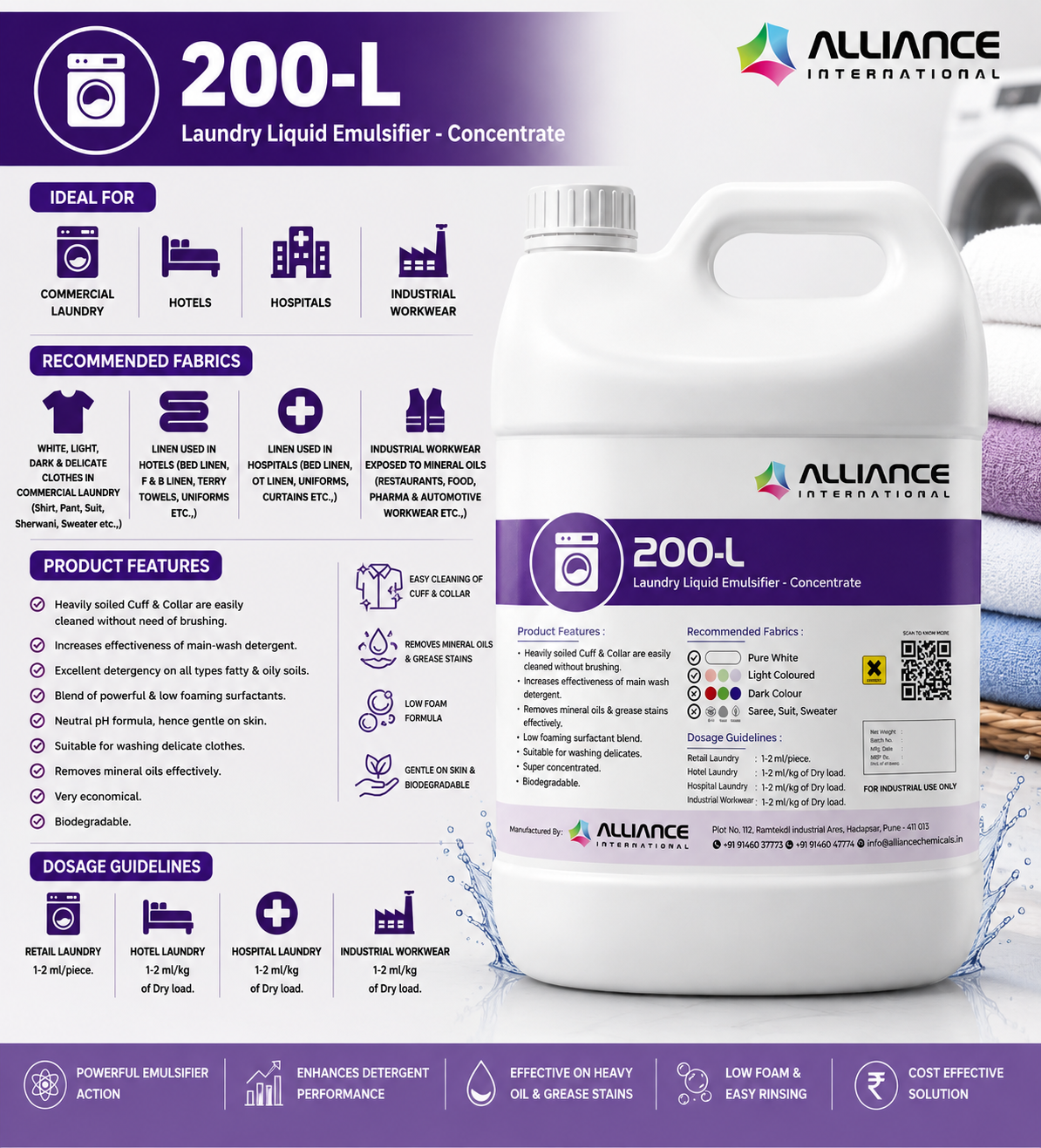 | Emulsifiers & Boosters ₹11000 Alliance's 200-L is a specially formulated laundry liquid emulsifier used along with main-wash detergent to assist in the removal of heavy soils... View product → |