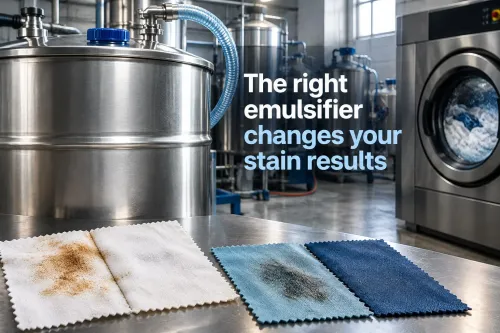


A damaged or disappointing delicate garment is not automatically evidence that PRIME is the wrong detergent. By checking the care label, fibre, water, machine settings and wash result in the right order, you can separate detergent faults from mechanical, temperature, rinsing, drying and hard-water problems before changing a commercial formula.
Key takeaways
- Confirm the care label and fibre composition before adding PRIME.
- Check Mumbai water hardness before increasing the chemical dose.
- Trace colour loss, residue and damage back to a specific process step.
- Run a controlled test load before changing production settings.
Decide whether PRIME belongs in the load
Put PRIME only in a verified permanent-colour cotton, polyester or blend load when the care label and fibre composition support it. Read the ISO 3758:2023 symbols for washing, bleaching, drying, ironing and professional cleaning before choosing the cycle; a mainline detergent is not automatically suitable for silk, wool, rayon, viscose, elastane-rich or structured garments.
- Isolate garments marked for professional cleaning, those with unknown fibre histories, and items showing previous shrinkage or colour-transfer damage.
- Reject dark or unstable dyes, bonded or laminated coatings, sequins, beads, metal trims and glued components until they pass a hidden-seam colourfastness test with a damp white cloth.
- Treat wool and silk as protein fibres. Do not assume a protease-containing product is safe; use fibre-appropriate chemistry, cool temperatures and low agitation.
- Treat rayon and viscose as wet-weak fibres. Prolonged soaking, forceful extraction and tumbling can cause stretching, creasing, fuzzing or distortion, so judge dimensional change after drying.
- Keep chlorine bleach out of general delicate processing. Oxygen bleach also needs a fibre and colourfastness check.
- Approve PRIME only when the label permits washing, the dye does not bleed, and the garment has no fragile finish or construction feature that the process could loosen.
This triage prevents prime can garment cleaning issues from being blamed on dosing. For prime can troubleshooting delicate clothes cleaning problems in Mumbai, isolate any failed item before changing the formula; the garment category is the first variable to remove.
Trace the defect from symptom to process cause
Record the defect before changing PRIME: photograph the fabric, note the fibre, colour group, finish, machine, shift, product lot, dose per kilogram, bath pH, temperature, time, rinse count and extraction speed. A defect on one machine or shift points first to process control, not reformulation.
1. For bleeding or back-staining, separate the affected fibre and colour group. Check dye stability, temperature, alkalinity, contact time and mechanical action, then retest in a fresh bath with lower temperature and agitation.
2. Treat dulling as a redeposition, optical-brightener, abrasion or bleach-compatibility problem. Yellowing points to heat, residue or oxidation; check the fabric before adding chemistry.
3. Greying or oily soil can result from an overloaded drum, cold water, short contact time, poor dispersion or redeposition. Check the dosing pump, injection line, fill volume and whether detergent entered as a concentrated slug.
4. A stiff hand, streaks, sour odour or skin-irritating residue calls for a correctly dosed rinse-only comparison. Check final-rinse conductivity or alkalinity before increasing detergent, and run a no-softener control because cationic softener can reduce towel or microfibre absorbency and build up.
5. Shrinkage, pilling and seam distortion indicate temperature, tumbling, extraction force, abrasion or fibre weakness, especially in viscose and rayon. Residual odour in Mumbai’s humidity requires checks on extraction, drying time, washer hygiene, storage and air circulation.
This sequence supports prime detergent delicate fabric troubleshooting and prevents prime can garment cleaning issues from being blamed on chemistry alone. Never use chlorine bleach as a general fix; oxygen bleach still needs fibre and colourfastness checks.
Measure Mumbai water before changing the dose
Test the actual incoming water and wash-bath water before changing PRIME’s dose. A city-wide hardness or TDS assumption can misdiagnose prime liquid delicate laundry problems in Mumbai.
Sample these points separately:
| Sample | What it reveals | Record |
|---|---|---|
| Plant inlet | Source-water condition | Calcium-and-magnesium hardness as mg/L as CaCO3 |
| Storage tank | Building storage and contamination effects | Hardness and conductivity |
| Machine fill and wash bath | Water reaching the load | Hardness, conductivity and wash-bath pH |
Use a hardness titration kit or laboratory report for calcium and magnesium hardness. Use a calibrated conductivity or TDS meter as a separate indicator; TDS cannot replace hardness testing. Repeat after source or seasonal changes.
Hard water can reduce surfactant efficiency and leave deposits that appear as white scale, dull fabric, rough handle or residue around the drum and dosing point. Inspect the heating element, drum and rinse outlet. When residue is suspected, check final-rinse conductivity or alkalinity.
Confirm PRIME’s water range and dose per kilogram of dry load in its label or technical data sheet. Follow its stated liquor ratio, temperature, pH, wash time, rinse count, extraction and drying temperature; do not invent universal settings.
If the measured condition conflicts with the formula, compare PRIME with a soft-water formulation such as ULTRA in a controlled trial, rather than increasing detergent blindly. This evidence-based approach supports prime can troubleshooting delicate clothes cleaning problems in Mumbai.
Run a controlled test before altering production
A small, documented trial is safer than changing a full production batch. Separate cotton, polyester, blends, wool, silk and viscose, then divide each group by colour and finish. Never treat one group’s result as proof for another.
- Weigh the dry load, inspect and photograph representative garments, and retain an untreated or current-formula comparison load when hygiene and risk controls allow.
- Record the PRIME lot, machine, water source, hardness, conductivity, dose per kilogram, liquor ratio, wash-bath pH, temperature, wash time, rinse count, extraction speed and drying temperature.
- Dispense detergent into the wash liquor or specified dosing point, never as a concentrated slug onto fabric. Run a small load using the label or technical-data-sheet settings.
| Suspected problem | Controlled comparison | What to assess |
|---|---|---|
| Residue or odour | Add a rinse-only test | Final-rinse conductivity or alkalinity, hand feel and odour |
| Bleeding or back-staining | Use a fresh bath with lower temperature and agitation | Colour transfer and whiteness |
| Oily soil | Compare correct dose and dispersion, not a larger dose | Soil removal and redeposition |
After drying, check shrinkage, pilling, seam position and dimensional change. Calculate the rewash rate and record rejected pieces. Repeat only one changed variable at a time; stop immediately for bleeding, coating failure or fibre damage, and preserve the failed garment.
This method supports PRIME detergent delicate fabric troubleshooting and prime can troubleshooting delicate clothes cleaning problems in Mumbai without risking the next batch. Inspect dosing, fill volume and dispersion before reformulating.
Choose the formula from evidence, labels and fibre risk
Keep PRIME for a verified, colourfast mainline load when measured water condition, wash-bath pH and machine settings match the product documentation, and a comparison load cleans acceptably without fibre damage.
A cotton or polyester trial does not approve silk, wool, viscose, rayon, elastane, coated or dry-clean-only garments. Use a fibre-appropriate delicate wet-cleaning process only when the care label permits it, with compatible chemistry, low mechanical action and controlled drying.
| Load decision | Evidence required | Action |
|---|---|---|
| PRIME mainline | Permanent-colour cotton, polyester or blend; water, pH, dose and settings within documentation; no fibre damage | Keep PRIME |
| Delicate wet-cleaning | Label permits wet cleaning; fragile fibre, trim, coating or finish needs low agitation and controlled drying | Change the process |
| Alternative formulation | Water condition falls outside PRIME limits, or the controlled trial shows residue, poor cleaning or fibre damage | Compare another formula, including ULTRA where water conditions justify it |
Ask the supplier for the current label, technical data sheet, safety data sheet, ingredient or enzyme information, recommended water range, operating limits and compatibility notes for optical brighteners, bleach and softener. This evidence helps resolve prime detergent delicate fabric troubleshooting instead of guessing.
For prime liquid delicate laundry problems in Mumbai and prime can garment cleaning issues, Alliance International can support a documented site trial. Record water tests, machine settings, product lot, fabric-specific outcomes and rewash rate; retain the batch record so you can separate chemistry from pump calibration, scale, poor rinsing or humid-storage contamination.
Related products
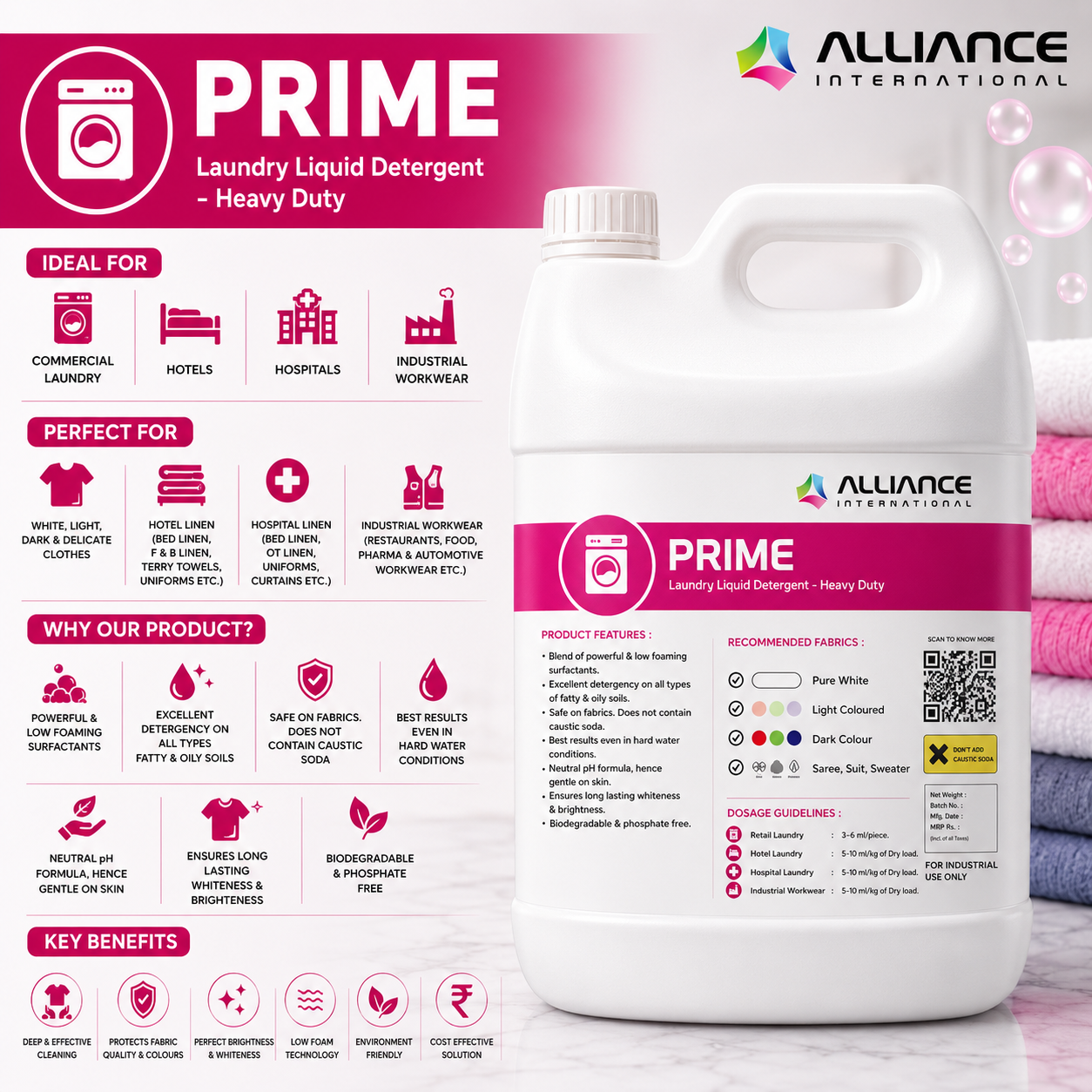 | Detergent Liquids ₹15000 Alliance's PRIME is an advanced laundry liquid detergent recommended for mainline washing of all types of permanent colour clothes of cottons,... View product → |
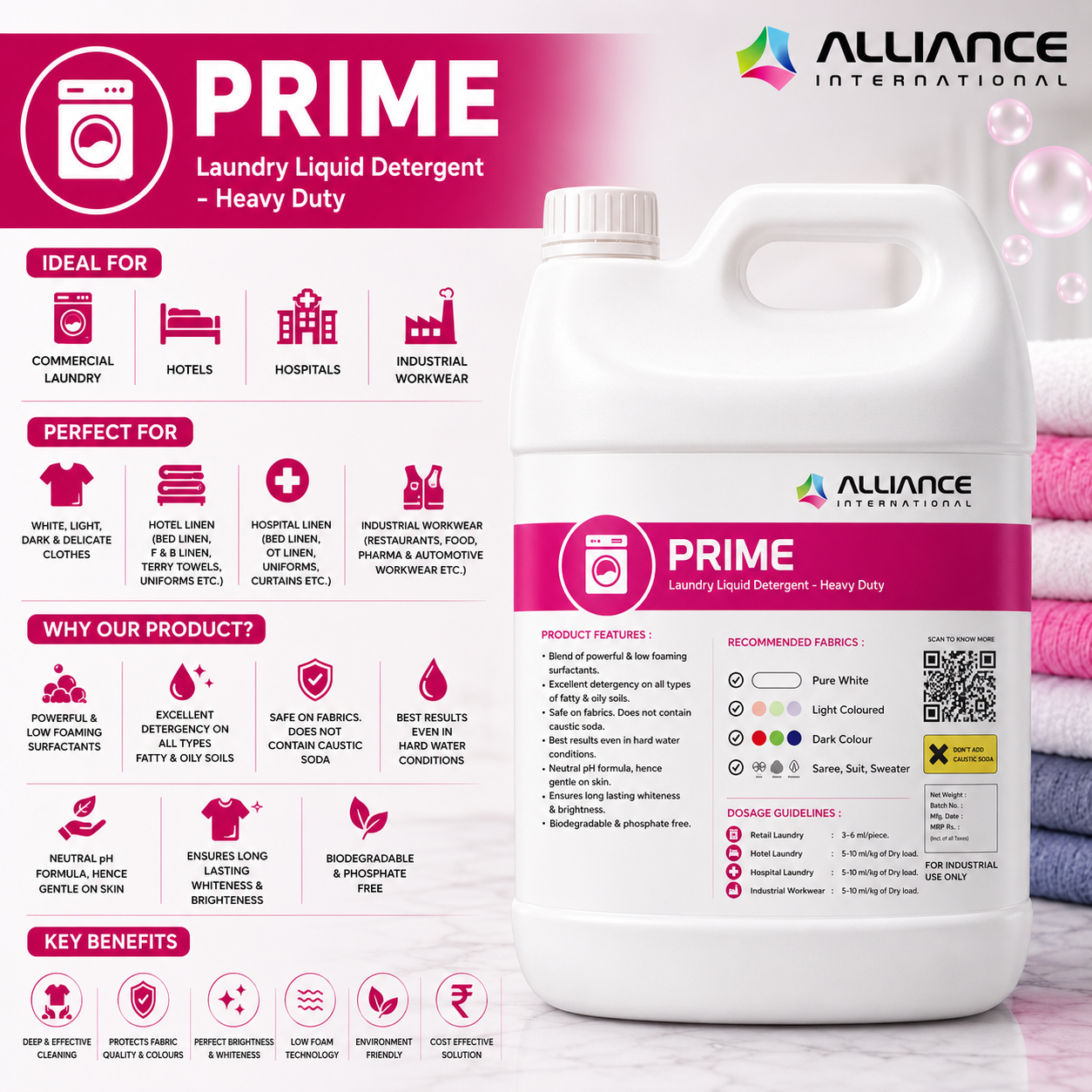 | Detergent Liquids ₹7500 Alliance's PRIME is an advanced laundry liquid detergent recommended for mainline washing of all types of permanent colour clothes of cottons,... View product → |
Frequently asked questions
When should PRIME be used in a laundry load?
Use PRIME only for verified permanent-colour cotton, polyester or blend loads when the care label and fibre composition support it. Do not assume it suits silk, wool, rayon, viscose, elastane-rich or structured garments.
How can you identify the cause of a garment-cleaning defect?
Match the symptom to the process record: review the care label, fibre composition, wash cycle, temperature, chemical dose, water quality, loading and rinse performance before changing the formula.
Why measure Mumbai water before changing the PRIME dose?
Water hardness and other local water conditions affect cleaning, residue and chemical performance. Measure the water first so you do not mask a water-quality problem by over-dosing.
How should you test a change before using it in production?
Run a controlled test with comparable garments, a recorded dose, fixed temperature and cycle settings, and a control load. Compare cleaning, colour, whiteness, residue and fabric feel before approval.
Related products
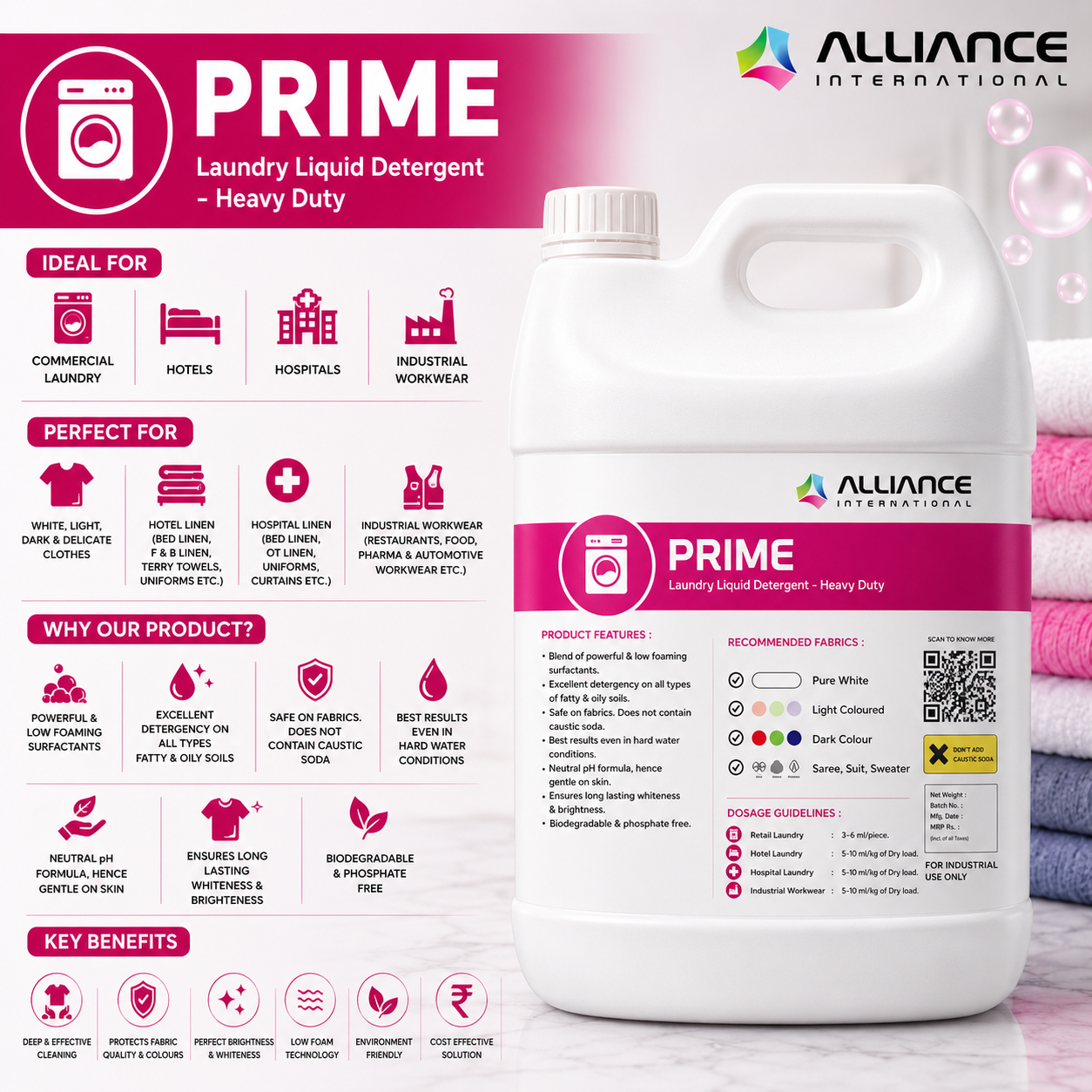 | Detergent Liquids ₹2000 Alliance's PRIME is an advanced laundry liquid detergent recommended for mainline washing of all types of permanent colour clothes of cottons,... View product → |
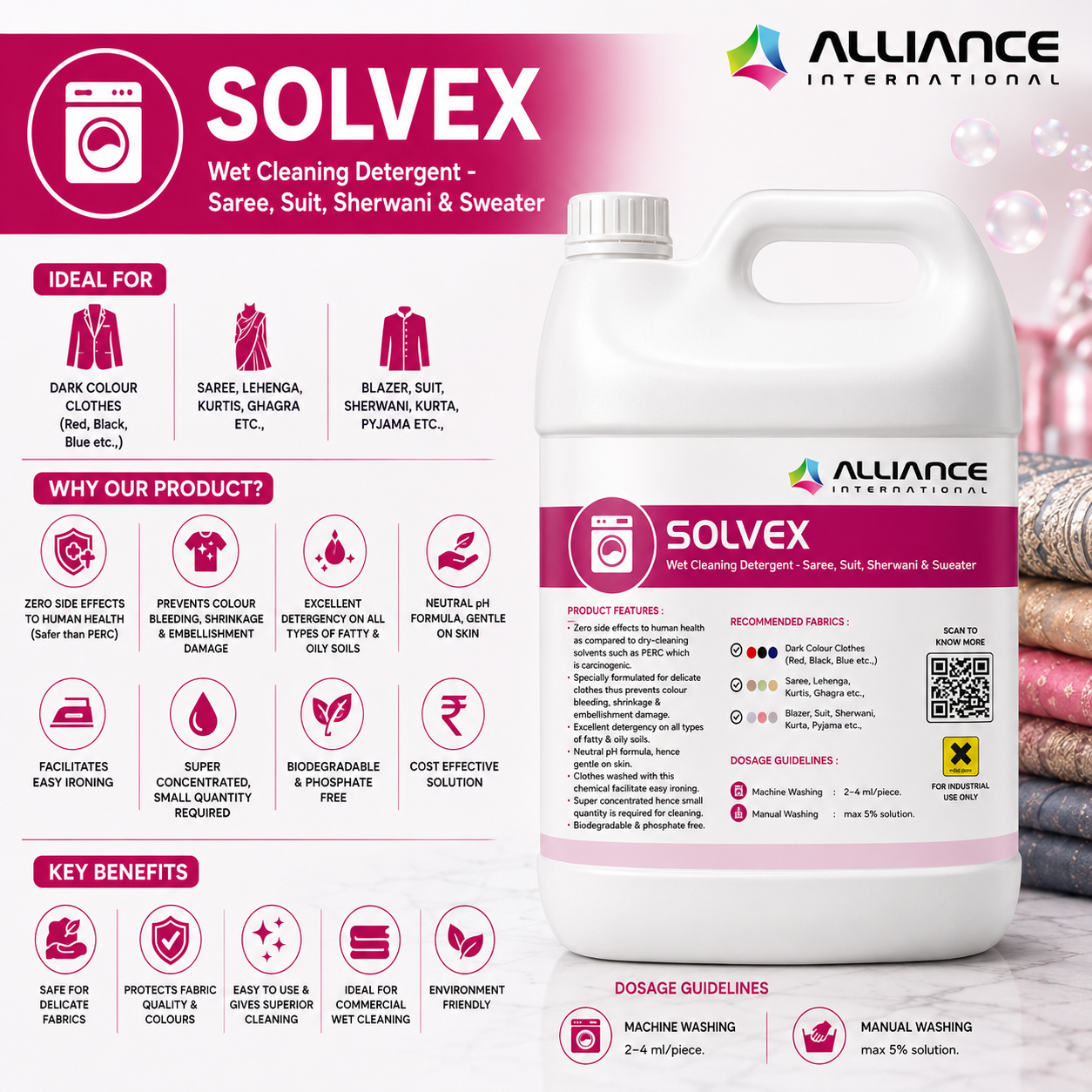 | Detergent Liquids ₹15000 Alliance's SOLVEX is a super concentrated delicate clothes liquid detergent recommended for wet cleaning of clothes found in commercial laundry which... View product → |
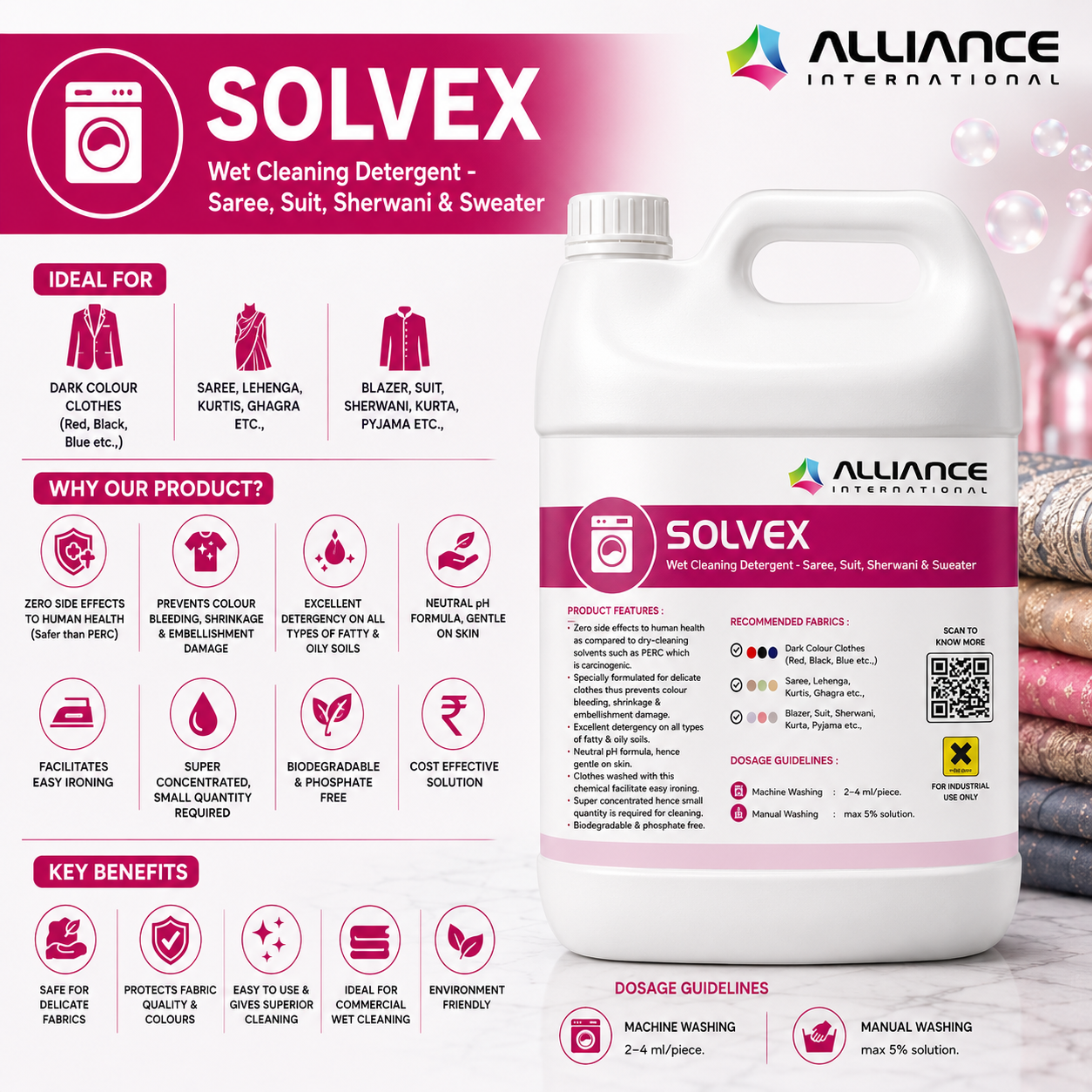 | Detergent Liquids ₹25000 Alliance's SOLVEX is a super concentrated delicate clothes liquid detergent recommended for wet cleaning of clothes found in commercial laundry which... View product → |
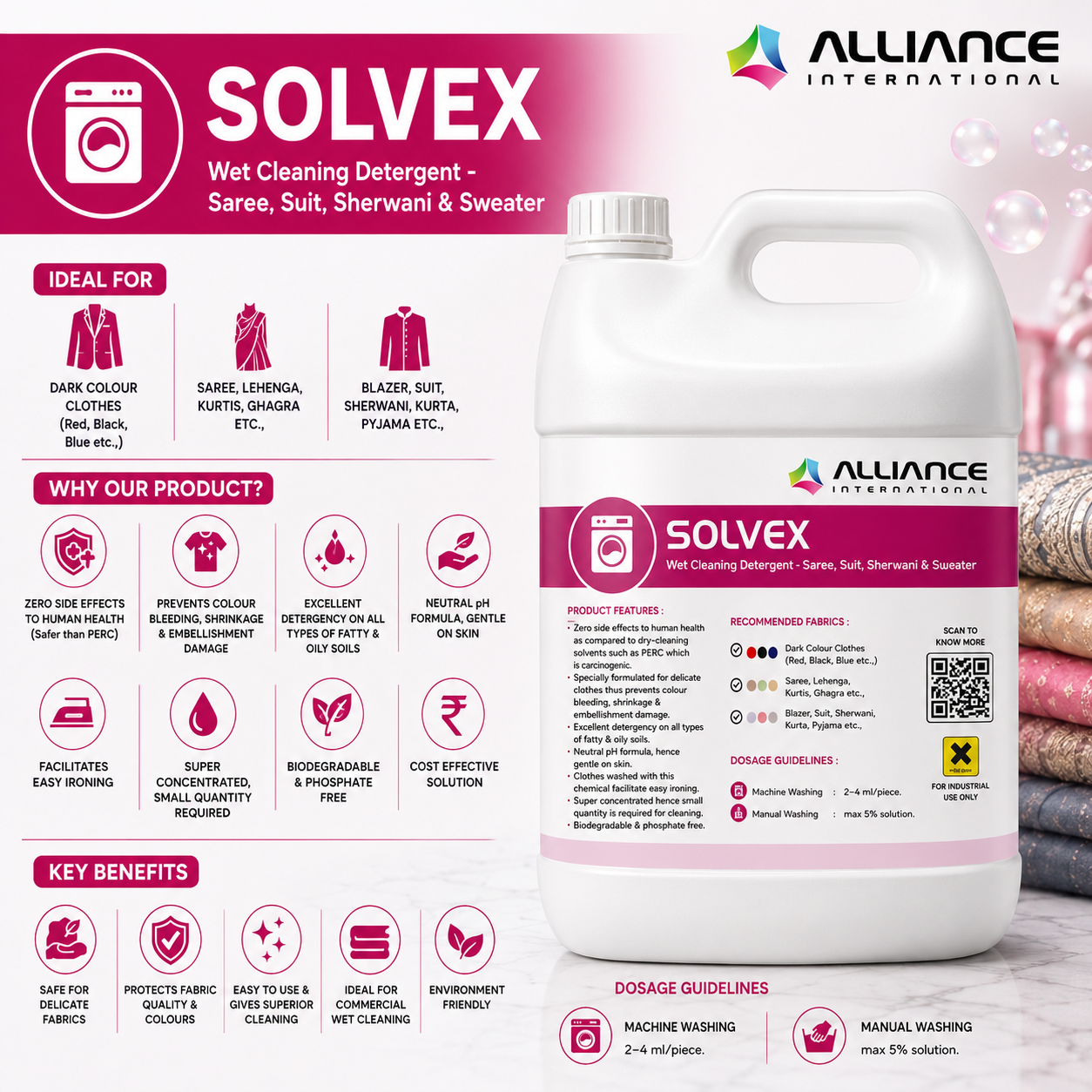 | Detergent Liquids ₹4000 Alliance's SOLVEX is a super concentrated delicate clothes liquid detergent recommended for wet cleaning of clothes found in commercial laundry which... View product → |